Hair Dryer Buying Guide: What Features Actually Matter?
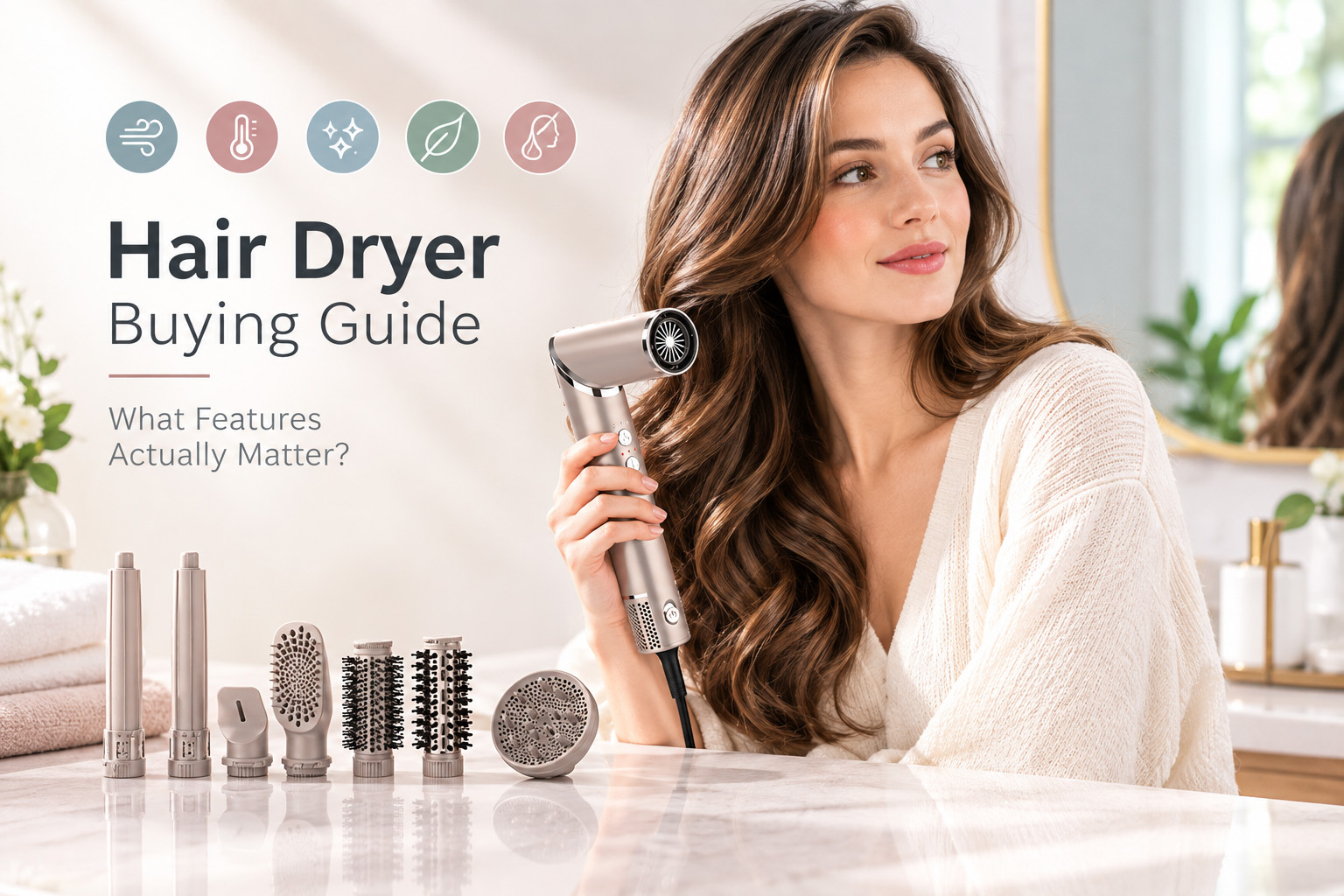
Hair Dryer Buying Guide: What Features Actually Matter?
Choosing a hair dryer can be surprisingly difficult. With so many models promoting high wattage, ionic technology, ceramic heating, multiple temperature settings, high-speed motors, and different attachments, it is easy to focus on specifications that sound impressive rather than features that actually improve your daily styling experience.
This Hair Dryer Buying Guide: What Features Actually Matter? explains the most important features to consider before buying a hair dryer. Whether you need a hair dryer for fine hair, thick hair, curly hair, frizzy hair, daily family use, or travel, the right features depend on your hair type, styling routine, and drying goals.
The best hair dryer is not necessarily the most expensive model or the one with the highest wattage. A good hair dryer should provide the right combination of airflow, temperature control, motor performance, attachments, weight, technology, and usability.

What Should You Look for in a Hair Dryer?
When choosing a hair dryer, focus on features that affect actual performance rather than simply counting the number of buttons or technologies.
The most important hair dryer features include:
- Motor power and airflow
- Wattage
- Heat and speed settings
- Cool shot function
- Ionic technology
- Ceramic or other heating technology
- Attachments
- Weight and ergonomic design
- Noise level
- Filter design and maintenance
- Safety certifications
- Voltage compatibility for travel
A hair dryer with a balanced combination of these features can be more useful than a model with one extremely high specification.
Hair Dryer Buying Guide: What Features Actually Matter?
The most important question in any Hair Dryer Buying Guide: What Features Actually Matter? is simple: which specifications make a noticeable difference when you actually use the dryer?
Let's look at the features one by one.
1. Airflow and Motor Performance
Airflow is one of the most important factors in a hair dryer's performance.
A powerful airflow can help remove water from wet hair more efficiently, potentially reducing the time your hair is exposed to heat. Good Housekeeping's 2026 testing evaluates hair dryers using measurements such as drying speed, airflow force, temperature, weight, and surface temperature.
Why Motor Performance Matters
The motor is responsible for generating the airflow. Different hair dryers use different motor designs, including traditional AC motors, DC motors, and newer high-speed digital motors.
For everyday users, the important question is not simply whether the motor sounds powerful.
Instead, consider:
- How strong and consistent is the airflow?
- Does the airflow remain stable during use?
- Does the dryer dry thick hair efficiently?
- Is the motor reasonably quiet?
- Is the dryer comfortable to hold?
A high-speed hair dryer with powerful airflow can be particularly useful for people with long or thick hair who want to reduce drying time.
Does Higher Motor Speed Always Mean Better?
Not necessarily.
A high RPM number can be attractive in product specifications, but RPM alone does not tell you everything about drying performance.
Airflow design, air pressure, motor efficiency, heating performance, and nozzle design all influence the final result.
Therefore, when comparing high-speed hair dryers, look at the entire airflow system rather than motor RPM alone.
2. Wattage: How Many Watts Does a Hair Dryer Need?
Wattage is one of the most commonly advertised hair dryer specifications.
In simple terms, wattage indicates the electrical power consumed by the dryer, but it should not be treated as the only measurement of performance.
Good Housekeeping's current testing guide notes that 1,500–2,000 watts is a common range for general hair-drying performance, while different hair types may benefit from different power levels.
Is Higher Wattage Better for Hair?
Not automatically.
A high-wattage hair dryer can provide strong heating and airflow, but actual drying performance also depends on motor efficiency and airflow design.
For example:
Fine or Thin Hair
A hair dryer for fine hair does not necessarily need extremely high power.
Lower heat and adjustable airflow can provide better control for delicate strands.
Thick or Coarse Hair
People with thick, long, or coarse hair may benefit from stronger airflow and higher power because more water needs to be removed.
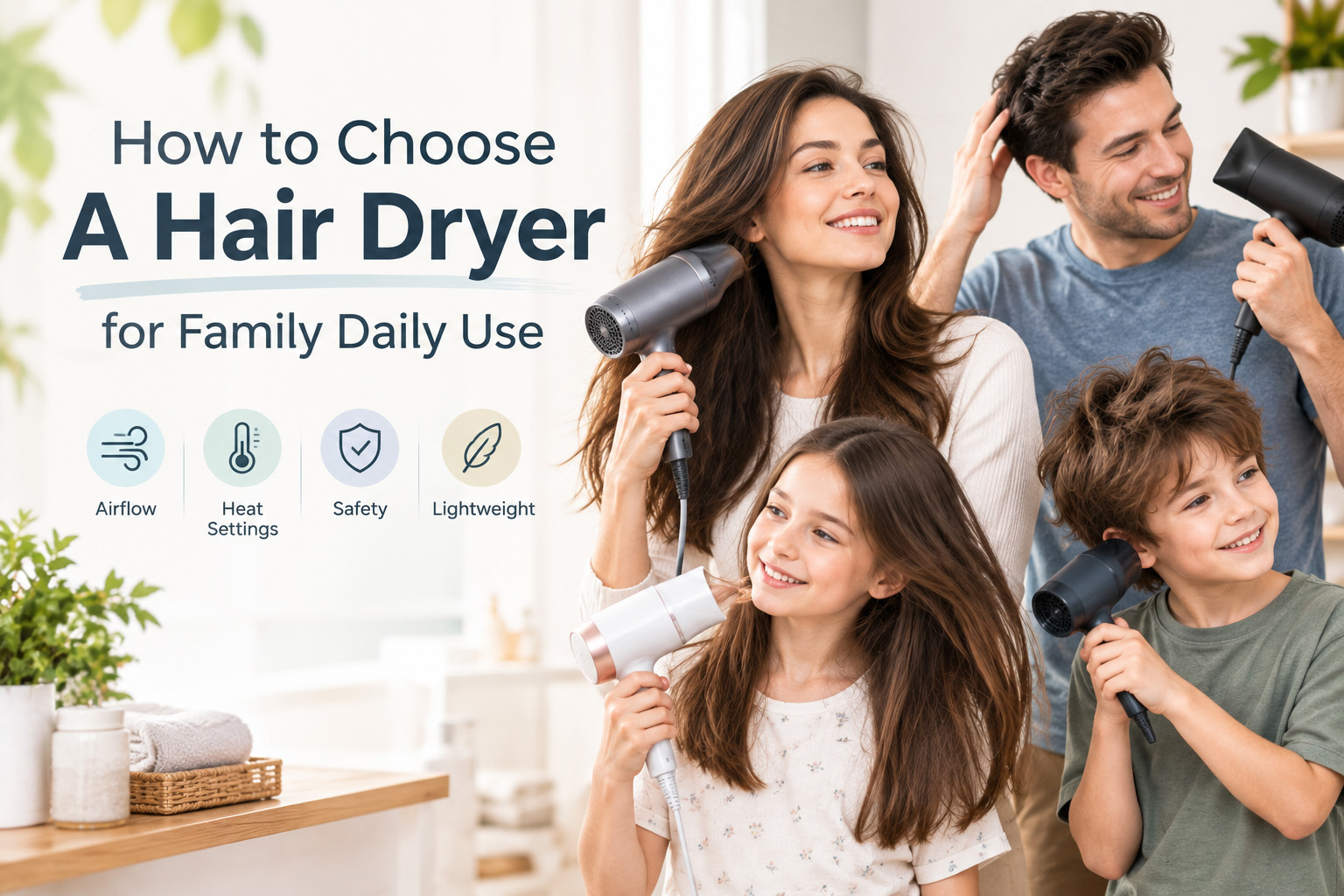
Daily Family Use
For a household hair dryer, a moderate-to-high power range combined with adjustable temperature and speed settings can provide greater versatility.
The key takeaway is:
Do not buy a hair dryer based on wattage alone.
3. Adjustable Heat Settings
Temperature control is one of the features that actually matters for everyday hair drying.
Different hair types respond differently to heat. Fine hair may require gentler temperatures, while thick or coarse hair may require stronger airflow and additional heat for efficient drying.
A good hair dryer should ideally provide multiple heat settings.
Why Multiple Heat Settings Matter
Adjustable heat allows you to change the temperature according to:
- Hair thickness
- Hair length
- Hair condition
- Styling technique
- Drying stage
For example, you can use stronger heat during the initial drying stage and reduce the temperature when finishing the style.
This makes a hair dryer with adjustable temperature settings more versatile than a basic model with only one temperature.
4. Speed Settings and Airflow Control
Heat is only one part of the equation.
Speed settings determine how much airflow reaches your hair.
A useful hair dryer should allow you to adjust both heat and airflow independently.
Low Speed
Useful for:
- Fine hair
- Finishing
- Controlled styling
- Sensitive areas around the face
Medium Speed
Useful for:
- Everyday drying
- Medium-density hair
- Brush styling
High Speed
Useful for:
- Thick hair
- Long hair
- Initial drying
- Faster water removal
Having multiple speed settings gives you more control over the drying process.
5. Cool Shot Button
A cool shot button is another practical feature that is easy to overlook.
The cool shot releases cooler air, which can be useful when finishing a hairstyle and helping the finished shape hold.
Good Housekeeping notes that its top-tested dryers include a cool-shot button and evaluates this function as part of usability and styling performance.
A hair dryer with cool shot button is especially useful for:
- Finishing blowouts
- Smoothing styled sections
- Setting volume
- Reducing continued heat exposure after styling
If you frequently use a round brush or concentrator nozzle, a dedicated cool shot button can be very convenient.
6. Ionic Technology: Is It Worth It?
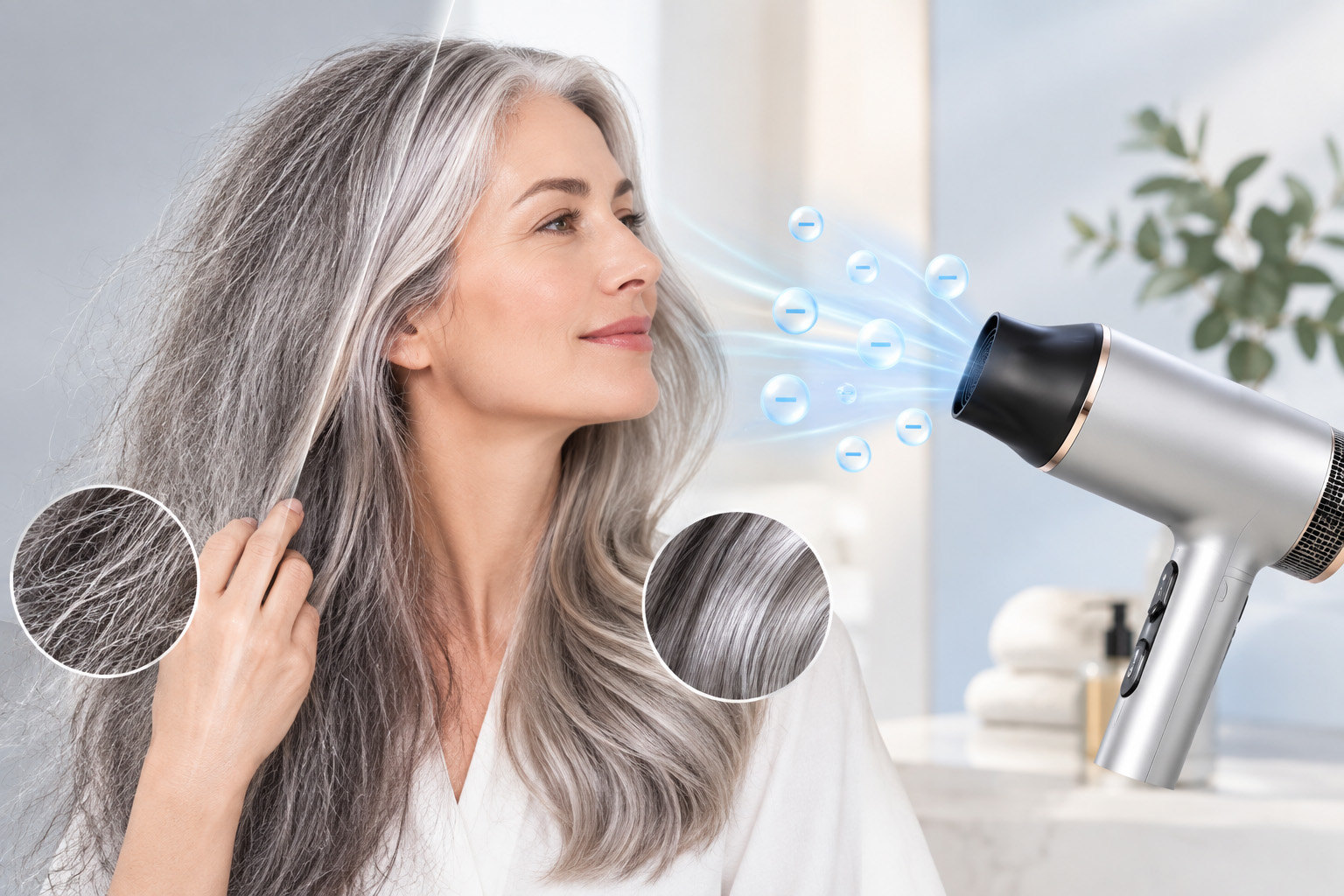
Ionic hair dryers are popular because they are designed to release negative ions during drying.
The main reason consumers choose an ionic hair dryer is to help reduce static and create a smoother-looking finish.
Testing reported by Good Housekeeping found visible differences in static and hair alignment when ionic technology was switched on and off.
Who Should Consider an Ionic Hair Dryer?
Ionic technology may be particularly attractive for people dealing with:
- Frizzy hair
- Static
- Flyaways
- Dry-looking hair
- Thick hair
- Curly or textured hair
However, ionic technology is not automatically necessary for everyone.
If your main priority is volume, extremely strong ionic performance may not be the only factor to consider. Your hair type and styling technique still matter.
7. Ceramic Hair Dryer: Does Ceramic Technology Matter?
Ceramic heating systems are designed to provide consistent heat distribution.
The idea is to reduce uneven heating and provide more controlled heat during drying.
However, technology names should not replace practical specifications.
When choosing between a ceramic hair dryer and another heating technology, also compare:
- Temperature control
- Airflow
- Heat consistency
- Motor performance
- Attachments
- Weight
- User reviews and testing
Current testing suggests that advertised technologies such as ceramic, tourmaline, and far-infrared can be difficult to distinguish based on technology claims alone.
Therefore, treat ceramic technology as one feature rather than the entire reason to purchase a dryer.
8. Attachments: Choose Them According to Your Hairstyle
Attachments can make a major difference.
The right attachment changes the way air reaches the hair and can make a dryer more versatile.
Concentrator Nozzle
A concentrator nozzle narrows the airflow.
It is useful for:
- Straight hairstyles
- Smooth blowouts
- Precise styling
- Controlling frizz
- Directing airflow along the hair shaft
A concentrator is especially useful when using a round brush or paddle brush.
Diffuser
A diffuser spreads airflow over a wider area.
It is particularly useful for curly hair and wavy hair because it can provide gentler airflow while helping maintain natural curl patterns.
Good Housekeeping recommends diffusers for curly hair because they distribute airflow more broadly and can help define curls and reduce frizz.
Styling Brush Attachments
Some modern dryers include smoothing brushes, volumizing brushes, or hot-air styling attachments.
These can be useful if you want a hair dryer and styler in one device.
If you frequently switch between drying, straightening, smoothing, and volumizing, a multi-attachment hair dryer can reduce the number of styling tools you need.
9. Weight and Ergonomic Design
A powerful hair dryer is not very useful if it becomes uncomfortable to hold after several minutes.
Weight and balance are especially important for people with:
- Long hair
- Thick hair
- Frequent blowouts
- Professional salon use
- Daily styling routines
A lightweight hair dryer can reduce hand and wrist fatigue.
But weight alone is not enough.
The position of the motor, handle shape, button placement, and overall balance also influence comfort.
A well-designed lightweight professional hair dryer should feel balanced rather than simply being light on a specification sheet.
10. Noise Level
Noise is another feature that many shoppers overlook.
If you use your hair dryer every morning, a loud motor can become frustrating.
Noise may be particularly important for:
- Early-morning routines
- Shared bathrooms
- Families
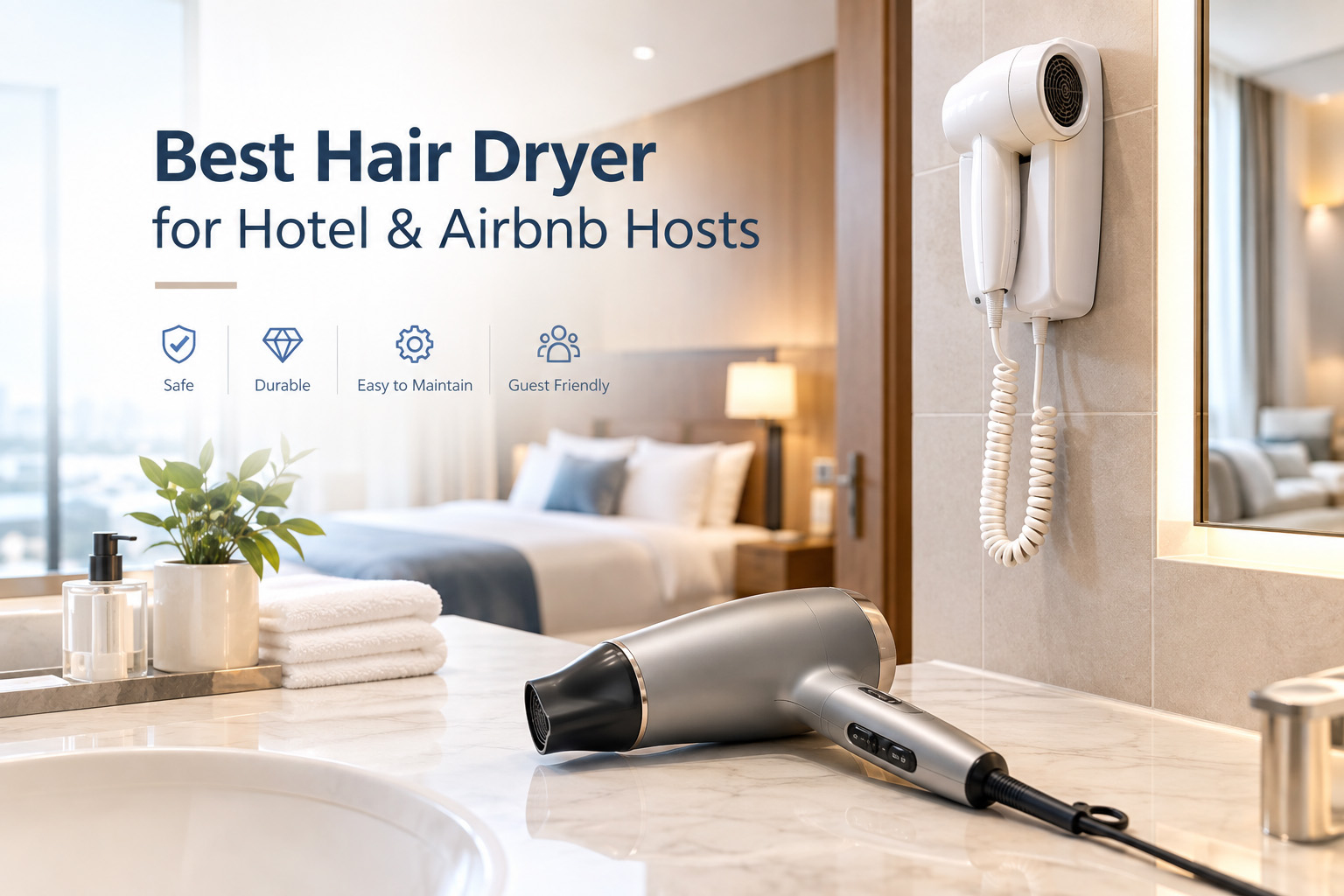
- Hotels
- Airbnb properties
- Professional salons
When comparing dryers, check independent noise testing when available rather than relying only on the manufacturer's phrase "quiet hair dryer."
11. Filter Design and Easy Maintenance
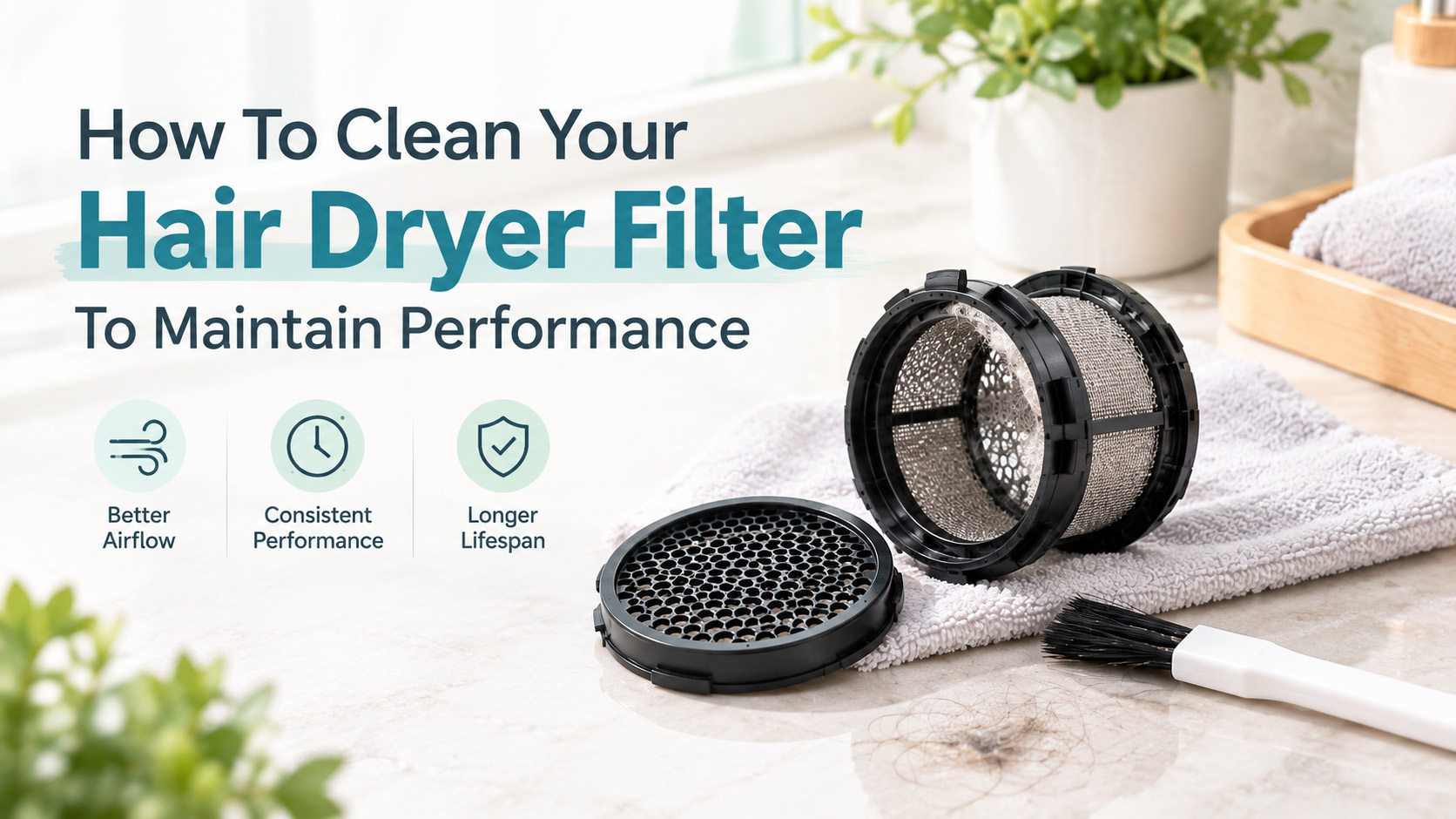
A removable or easy-to-clean filter is a practical long-term feature.
Hair, dust, and product residue can accumulate around the air intake.
A blocked filter can affect airflow and potentially make the dryer work harder.
Look for:
- Removable rear filter
- Easy filter access
- Clear cleaning instructions
- Durable filter construction
- Self-cleaning functionality, if available
For people who use a hair dryer every day, easy hair dryer filter cleaning can be an important part of maintaining consistent performance.
12. Safety Features and Certifications
A hair dryer is a high-powered electrical appliance that operates close to water and skin.
Safety should therefore be part of the buying decision.
Look for appropriate safety certifications and electrical compliance markings for your market.
Good Housekeeping specifically recommends checking safety verification marks such as UL, ETL, or TÜV/SÜD when purchasing a hair dryer.
Also consider:
- Overheat protection
- Automatic shutoff where applicable
- Heat-resistant housing
- Secure attachment connections
- Properly designed power cord
- Appropriate certification for your region
13. Dual Voltage for Travel
If you frequently travel internationally, voltage compatibility can be more important than having the most powerful motor.
A dual voltage travel hair dryer is designed to work with different electrical voltage systems when used correctly with the appropriate plug adapter.
Good Housekeeping's current travel hair dryer guide specifically highlights dual voltage as an important consideration for international travelers.
Before buying a travel hair dryer, check:
- Voltage range
- Plug type
- Wattage
- Weight
- Foldable design
- Storage size
Do not assume that a compact hair dryer is automatically suitable for international travel.
14. Which Hair Dryer Features Matter Most for Different Hair Types?
There is no single hair dryer that is ideal for every person.
Your hair type should influence which features receive the most attention.
Hair Dryer for Fine or Thin Hair
Look for:
- Low-temperature settings
- Adjustable airflow
- Lightweight design
- Concentrator nozzle
- Cool shot
- Good heat control
A hair dryer for fine thin hair should provide enough airflow to dry efficiently without requiring unnecessarily high heat.
Hair Dryer for Thick Hair
Look for:
- Strong airflow
- Powerful motor
- Multiple speed settings
- Higher power
- Wide airflow attachment
- Efficient heat distribution
A high-speed hair dryer for thick hair can help reduce drying time when the airflow system is well designed.
Hair Dryer for Curly Hair
Look for:
- Diffuser
- Adjustable speed
- Multiple heat settings
- Ionic technology if reducing static and frizz is a priority
- Gentle airflow options
A diffuser is one of the most useful accessories for maintaining natural curl patterns.
Hair Dryer for Frizzy Hair
Look for:
- Ionic technology
- Concentrator nozzle
- Adjustable temperature
- Cool shot
- Consistent airflow
A combination of controlled airflow and appropriate styling technique can be more important than simply choosing the dryer with the highest power.
15. Do You Need a Professional Hair Dryer?
A professional or salon-grade hair dryer can be useful for people who dry and style their hair frequently.
However, professional does not automatically mean better for every user.
Consider a professional model if you need:
- Frequent daily use
- Strong airflow
- Long operating life
- Multiple attachments
- More precise controls
- Comfortable ergonomic design
For occasional home use, a simpler dryer may provide everything you need.
The important thing is to match the product to your actual routine.
16. What Features Are Mostly Marketing?
A major purpose of this Hair Dryer Buying Guide: What Features Actually Matter? is to separate useful specifications from marketing language.
Be careful when choosing a product based entirely on:
- Extremely high RPM numbers
- Extremely high wattage
- Too many unnecessary modes
- Unclear "advanced technology" claims
- Expensive materials without measurable benefits
- Large numbers of accessories you will never use
A specification is only useful when it solves a real problem.
For example, if you have curly hair, a diffuser may be more valuable than an extra styling mode you will never use.
If you have fine hair, precise low-heat control may matter more than maximum wattage.
17. Hair Dryer Buying Checklist
Before buying a new hair dryer, use this simple checklist.
Performance
- Does it provide strong and consistent airflow?
- Is the motor suitable for your hair type?
- Is the drying speed reasonable?
Temperature and Speed
- Does it have multiple heat settings?
- Does it have multiple speed settings?
- Does it include a cool shot?
Technology
- Is ionic technology useful for your hair?
- Does the heating system provide consistent heat?
- Are the technology claims supported by useful specifications?
Attachments
- Does it include a concentrator?
- Does it include a diffuser?
- Are styling brushes included if you need them?
Comfort
- Is it lightweight enough for your routine?
- Is the handle comfortable?
- Is the dryer well balanced?
- Is the noise level acceptable?
Maintenance
- Is the filter easy to remove?
- Is cleaning simple?
- Does the product provide clear maintenance instructions?
Travel
- Is it dual voltage?
- Is it compact?
- Is the cord convenient?
- Does it fit easily into your luggage?
18. How Much Should You Spend on a Hair Dryer?
Price should be considered together with features and actual usage.
An expensive hair dryer may offer better motors, more precise controls, improved ergonomics, additional attachments, or advanced technology.
However, a lower-priced hair dryer can still be suitable if it provides the features you actually need.
Instead of asking:
"What is the most expensive hair dryer I can buy?"
Ask:
"Which hair dryer features will I actually use?"
For example, someone who only dries straight, medium-length hair may not need a large attachment system.
Someone with curly, thick, or long hair may benefit more from strong airflow, multiple settings, and specialized attachments.
19. How to Choose a Hair Dryer: A Simple Decision Process
If you are still unsure which model to buy, follow these steps.
Step 1: Identify Your Hair Type
Determine whether your hair is:
- Fine
- Medium
- Thick
- Straight
- Wavy
- Curly
- Coily
- Frizz-prone
Step 2: Identify Your Main Goal
Do you want to:
- Dry hair faster?
- Reduce frizz?
- Create volume?
- Define curls?
- Create straight hairstyles?
- Replace several styling tools?
Step 3: Select the Most Important Features
For example:
Fine hair → low heat + adjustable airflow
Thick hair → strong airflow + powerful motor
Curly hair → diffuser + adjustable settings
Frizzy hair → ionic technology + concentrator
Travel → lightweight + compact + dual voltage
Step 4: Compare Real-World Usability
Finally, compare:
- Weight
- Noise
- Cord
- Filter
- Attachments
- Controls
- Safety features
This approach makes it easier to choose a hair dryer based on your actual needs instead of marketing claims.
FAQ: Hair Dryer Buying Guide
What is the most important feature in a hair dryer?
Airflow, temperature control, and usability are among the most important features. The ideal combination depends on your hair type and styling goals.
Is a higher wattage hair dryer better?
Not necessarily. Wattage indicates electrical power, but drying performance also depends on airflow, motor design, heating system, and controls.
Is ionic technology worth it in a hair dryer?
Ionic technology can be useful for reducing static and improving the appearance of smoothness, particularly for frizzy or static-prone hair. However, it should be considered alongside airflow, temperature control, and attachments.
Is ceramic better than ionic?
They serve different purposes. Ionic technology primarily relates to ion generation and static reduction, while ceramic heating relates to heat distribution. Neither feature alone determines whether a hair dryer is right for you.
What is the best hair dryer for thick hair?
Look for strong and consistent airflow, a powerful motor, multiple speed settings, adjustable heat, and attachments suited to your styling routine.
What is the best hair dryer for fine hair?
A hair dryer for fine hair should provide good airflow with controllable, lower-temperature settings. Lightweight construction and precise controls can also make styling easier.
Do I need a diffuser?
If you have curly or wavy hair and want to maintain your natural texture, a diffuser can be a very useful attachment.
Is a cool shot button necessary?
It is not essential for basic drying, but it is useful for finishing hairstyles and reducing continued exposure to hot air.

Final Thoughts: Focus on Features You Will Actually Use
The most important lesson from this Hair Dryer Buying Guide: What Features Actually Matter? is that more features do not automatically mean a better hair dryer.
A good buying decision starts with your hair type and daily routine.
If you have thick hair, prioritize airflow and motor performance.
If you have fine hair, prioritize heat control and gentle settings.
If you have curly hair, look for a diffuser and adjustable airflow.
If you struggle with frizz and static, ionic technology may be useful.
If you travel frequently, prioritize lightweight construction, compact design, and dual voltage.
Most importantly, look beyond impressive numbers and marketing claims. A well-designed hair dryer should combine effective airflow, adjustable heat, useful attachments, comfortable handling, easy maintenance, and appropriate safety features.
That is what actually matters when choosing a hair dryer for everyday use.

📬 Contact Information
Contact Person: Jenny
Tel / WhatsApp / WeChat: +86 137 1719 2238
Address: No. 12, Donghuan 2nd Road, Huangjiang Town, Dongguan, Guangdong, China
For partnership inquiries, distribution, private label OEM, or large-scale projects, please reach out directly.
Welcome to Hongya!
17+ years OEM/ODMproduction experience.
Main products include: HairDryers, Hot Air Brush, HairStraighteners, Hair Curlers,Hair Straightener Brushes,etc.
20+R&D staff
280+ employees.
15000+ ㎡ factories.
100,000+ PCS MonthlyProduction.
Currently developing200+ products.
Patents/Certifications support Online Query.

How to chooes A hair dryer for family daily use: A Complete Buying Guide
Related Article