How to chooes A hair dryer for family daily use: A Complete Buying Guide
How to chooes A hair dryer for family daily use: A Complete Buying Guide
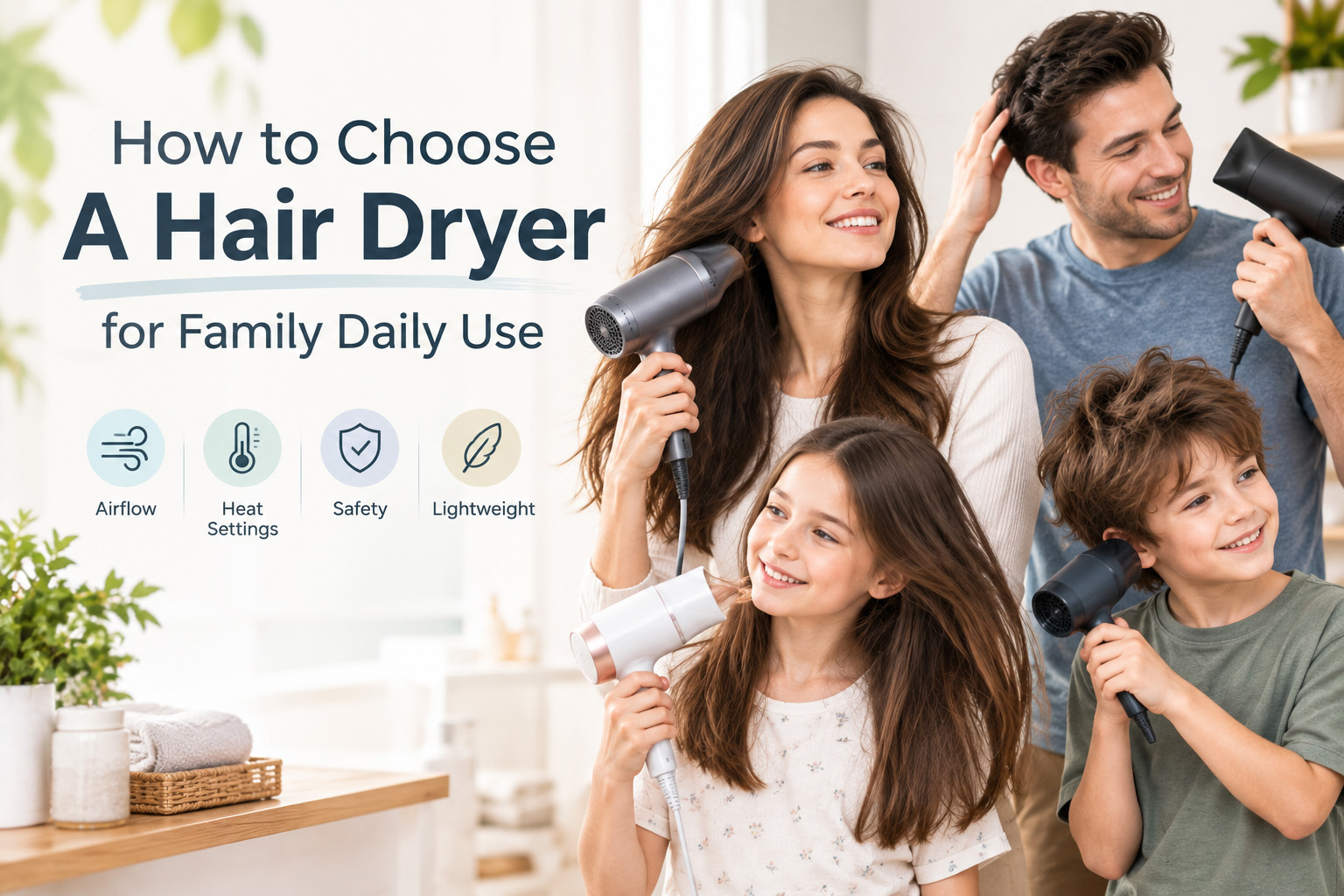
Choosing one hair dryer for everyone in the family can be more difficult than it seems.
One family member may have long, thick hair. Another may have fine or short hair. Someone may need a diffuser for curly hair, while another person may simply want fast drying before work or school.
So, how to chooes A hair dryer for family daily use?
The answer is not simply to buy the most powerful or most expensive model.
A good family hair dryer should offer a practical combination of airflow, heat control, speed settings, suitable attachments, comfortable weight, reasonable noise, safety features, and easy maintenance.
Consumer Reports recommends looking for multiple heat and speed settings and choosing attachments according to hair type. It also notes that wattage is only one part of the performance equation.
This guide explains how to chooes A hair dryer for family daily use, what features matter most, and how to choose a model that can work for different family members.

How to chooes A hair dryer for family daily use?
If you want the short answer, look for a hair dryer with:
- Multiple heat settings
- Multiple airflow speeds
- Strong but controllable airflow
- A cool-shot function
- Useful attachments
- Comfortable weight
- Easy-to-clean filter
- Appropriate heat control
- A reliable motor
- Safety-conscious design
- A reasonable noise level
For a family hair dryer, versatility is usually more important than maximum power.
A dryer with adjustable airflow and temperature can accommodate more people and more hair types than a model designed around only one drying style.
The American Academy of Dermatology recommends using low or medium heat when using heat-styling tools because excessive heat can damage hair.
Why Choosing a Hair Dryer for Family Daily Use Is Different
A hair dryer used by one person only needs to match one person's hair type and styling habits.
A family hair dryer has a different job.
It may need to handle:
- Fine hair
- Thick hair
- Long hair
- Short hair
- Straight hair
- Wavy hair
- Curly hair
- Children's hair
- Different styling routines
This makes adjustability especially important.
One Hair Dryer, Multiple Hair Types
For example, a person with fine hair may prefer lower heat and controlled airflow.
Someone with thick, long hair may need stronger airflow to reduce drying time.
A person with curly hair may need a diffuser.
Someone styling straight hair may prefer a concentrator nozzle.
This is why a versatile hair dryer can be more practical for family use than a highly specialized model.
What Features Should a Family Hair Dryer Have?
1. Multiple Heat Settings
Temperature control is one of the most important features in a family hair dryer.
Different hair types do not require the same amount of heat.
A hair dryer with only one or two temperature options gives users less control.
Consumer Reports recommends at least three heat settings so users can adjust the dryer to different hair types and styling needs.
Why Heat Control Matters
Fine hair generally does not need extremely high heat.
Thick or dense hair may require more drying power, but that does not mean the highest temperature should always be used.
The AAD recommends low or medium heat to help reduce heat-related hair damage.
For a family hair dryer, look for:
- Low heat
- Medium heat
- Higher heat
- Cool air or cool-shot function
This gives different family members more flexibility.
2. Multiple Airflow Speeds
Heat and airflow are not the same thing.
Temperature controls how hot the air becomes, while airflow controls how strongly the air moves.
A good family hair dryer should ideally allow users to adjust both independently.
Why Adjustable Airflow Is Useful
High airflow can help with quick rough drying.
Lower airflow can provide more control when styling.
Consumer Reports notes that different speed settings can provide different levels of control and styling options.
Therefore, when researching how to chooes A hair dryer for family daily use, do not look at temperature settings alone.
Check the airflow settings too.
How to Choose a Hair Dryer Based on Hair Type
Different family members may need different settings.
Hair Dryer for Fine Hair
Fine hair generally benefits from controlled airflow and moderate temperatures.
A very aggressive airflow can make fine hair difficult to manage.
Look for:
- Low or medium heat
- Adjustable airflow
- Lightweight design
- Concentrator nozzle
- Cool-shot function
The goal is controlled drying rather than simply maximum power.
Hair Dryer for Thick Hair
Thick hair can take considerably longer to dry.
Consumer Reports notes that people with thick or long hair should consider a dryer capable of reducing drying time.
For thick hair, consider:
- Strong airflow
- Multiple speed settings
- Higher available heat
- Efficient motor
- Wide airflow option
- Concentrator or appropriate styling attachment
However, strong airflow does not mean you need to use maximum heat throughout the entire drying process.
Hair Dryer for Long Hair
Long hair can require more time and more airflow.
When choosing a family hair dryer for long hair, consider both drying speed and control.
A powerful airflow can remove excess moisture quickly.
Then, a lower speed and appropriate attachment can be used for finishing and styling.
Hair Dryer for Curly Hair
Curly and textured hair often benefits from a diffuser.
Consumer Reports specifically recommends considering a quality diffuser for curly hair types.
When choosing a family hair dryer, look for:
- Diffuser compatibility
- Adjustable airflow
- Multiple heat settings
- Lower-speed option
- Cool-shot function
A diffuser can help distribute airflow more gently across curls instead of concentrating air in one small area.
Hair Dryer for Children's Hair
A family hair dryer may also be used for children.
For children, temperature control becomes particularly important.
Instead of focusing on maximum heat, parents should prioritize:
- Lower heat settings
- Gentle airflow
- Easy controls
- Comfortable handling
- Appropriate distance from the hair
- Automatic safety features where available
The AAD also recommends lower heat when using heat on children's hair.
How Important Is Hair Dryer Wattage for Family Use?
Wattage is one of the most commonly advertised hair dryer specifications.
But higher wattage does not automatically mean better performance.
Consumer Reports explains that wattage indicates the amount of power the appliance uses, while drying performance also depends on heat and airflow.
What Does Wattage Tell You?
Wattage can provide information about the electrical power of the appliance.
However, it does not tell you everything about:
- Airflow quality
- Motor efficiency
- Temperature control
- Noise
- Ergonomics
- Attachment design
- Drying performance
Therefore, don't choose a family hair dryer based on wattage alone.
Wattage vs Airflow
A better buying approach is to consider:
Motor + airflow + heat control + design + attachments
rather than:
Wattage = performance
This is particularly important when comparing different hair dryers.
Is a Powerful Hair Dryer Better for Family Use?
Not necessarily.
A powerful hair dryer can be useful for thick or long hair because it may reduce drying time.
But a family dryer needs to work for different users.
If the dryer only performs well at maximum power, it may be less suitable for fine hair or children.
The better approach is to choose a model that provides power when needed and control when required.
Why a Cool Shot Button Matters
A cool-shot button is a useful feature for family hair styling.
It allows users to switch from warm air to cool air during or after styling.
Benefits of Cool Air
Cool air can help with finishing a hairstyle and provides an alternative to continuously using heat.
It is especially useful when:
- Finishing a blowout
- Styling with a round brush
- Smoothing sections of hair
- Setting curls
- Reducing continued heat exposure
A cool-shot function is therefore a useful feature to consider when learning how to chooes A hair dryer for family daily use.
Which Hair Dryer Attachments Are Best for Family Use?
Attachments can make a hair dryer much more versatile.
Concentrator Nozzle
A concentrator focuses airflow into a narrower stream.
It can be useful for:
- Straight hair
- Blowouts
- Smoothing
- Root styling
- Precision drying
Diffuser
A diffuser spreads airflow over a larger area.
It is particularly useful for:
- Curly hair
- Wavy hair
- Textured hair
- Gentle drying
For a family with different hair types, a diffuser can significantly increase the versatility of the hair dryer.
Comb or Wide-Tooth Attachment
Some modern hair dryers include comb-style attachments.
These can be useful for certain hair types and styling routines.
However, attachment selection should be based on the actual hair types in your household rather than the number of accessories included in the box.
Why Hair Dryer Weight Matters for Family Daily Use
A hair dryer may only weigh a few pounds, but repeated use can make weight an important consideration.
This is especially true when:
- Hair is long
- Drying takes a long time
- The user has limited arm strength
- Parents dry children's hair
- Multiple people use the dryer every day
Consumer Reports includes weight and ease of use among the characteristics it evaluates in hair dryer testing.
What Is the Ideal Weight?
There is no single ideal weight for every family.
Instead, look for a model that feels:
- Balanced
- Comfortable to hold
- Easy to maneuver
- Not excessively front-heavy
- Comfortable during a complete drying session
A slightly less powerful dryer that is comfortable to use can sometimes be more practical for everyday family use than a heavier professional-style model.
Should a Family Hair Dryer Be Quiet?
Noise is another factor that is easy to overlook.
A hair dryer can be used early in the morning, late at night, or while other family members are nearby.
A quieter motor can make the overall experience more comfortable.
Consumer Reports describes a good hair dryer as ideally being speedy, relatively quiet, and comfortable to hold.
When comparing products, look for information about:
- Noise level
- Motor design
- Vibration
- User reviews
- Comfort during longer sessions
However, don't choose a dryer based on a manufacturer's "quiet" claim alone. Independent testing can be more useful when available.
Should You Choose an Ionic Hair Dryer for Family Use?
Ionic technology is commonly marketed as a way to reduce static and frizz.
Consumer Reports notes that ionic, ceramic, and tourmaline technologies are common features in modern hair dryers and may be marketed for frizz, static, and drying efficiency.
However, ionic technology should not be the only deciding factor.
When choosing how to chooes A hair dryer for family daily use, prioritize the fundamentals first:
- Heat control
- Airflow control
- Appropriate attachments
- Comfortable design
- Reliable performance
- Easy maintenance
Then consider ionic technology as an additional feature.
Ceramic vs Ionic vs Tourmaline Hair Dryer
These terms can make hair dryer shopping confusing.
Ionic
Often associated with reducing static and controlling flyaways.
Ceramic
Ceramic heating elements are commonly promoted for more even heat distribution.
Tourmaline
Tourmaline is often used in combination with ionic technology.
The important point is that these technologies should not replace basic performance considerations.
A hair dryer with excellent marketing terminology but poor airflow or limited temperature control may not be practical for a family.
What Motor Should a Family Hair Dryer Have?
The motor is one of the most important internal components.
A strong motor can provide consistent airflow and support faster drying.
Some modern hair dryers use brushless motors.
Consumer Reports notes that brushless motors have less friction and tend to last longer than traditional brushed motor designs.
Brushless Motor Benefits
Potential advantages include:
- Reduced friction
- Consistent performance
- Long-term durability
- High-speed operation
- Suitable for frequent use
For a family that uses the same hair dryer every day, motor quality can be more important than simply choosing the highest wattage.
How Much Should You Spend on a Family Hair Dryer?
A family hair dryer does not necessarily need to be the most expensive model available.
Instead, compare the features that your household actually needs.
Budget Hair Dryer
A budget model may be sufficient if it provides:
- Multiple heat settings
- Multiple speed settings
- Adequate airflow
- Basic attachments
- Comfortable handling
- Easy maintenance
Mid-Range Hair Dryer
A mid-range model may add:
- Better motor performance
- Better ergonomics
- More attachments
- Improved airflow
- Ionic technology
- Better temperature control
Premium Hair Dryer
Premium models may offer:
- Advanced motor technology
- More precise temperature control
- Sensors
- Specialized attachments
- Lower weight
- Advanced airflow management
- Additional convenience features
Consumer Reports' recent testing found that some higher-end models performed better in areas such as design, functionality, and ease of use, but that does not mean price alone determines whether a dryer is appropriate for a particular family.
Family Hair Dryer Buying Checklist
Before purchasing, compare these features.
| Feature | What to Look For |
|---|---|
| Heat settings | At least 3 useful temperature levels |
| Speed settings | Multiple airflow levels |
| Cool shot | Recommended |
| Motor | Reliable, efficient design |
| Airflow | Strong but controllable |
| Attachments | Concentrator and/or diffuser |
| Weight | Comfortable for daily use |
| Noise | Reasonable operating noise |
| Filter | Easy to remove and clean |
| Safety | Overheat protection and appropriate design |
| Controls | Simple enough for different family members |
| Cord | Long enough for your bathroom or vanity |
| Maintenance | Easy filter and attachment cleaning |

How to Choose a Hair Dryer for Different Family Members
One useful approach is to identify the needs of every user before buying.
For Parents
Prioritize:
- Fast drying
- Strong airflow
- Comfortable weight
- Multiple heat settings
- Easy maintenance
For Children
Prioritize:
- Low heat
- Gentle airflow
- Easy controls
- Safe handling
For Thick or Long Hair
Prioritize:
- Strong airflow
- Efficient motor
- Multiple speeds
- Suitable concentrator
For Curly Hair
Prioritize:
- Diffuser compatibility
- Lower airflow
- Multiple heat settings
- Cool shot
For Fine Hair
Prioritize:
- Lower heat
- Adjustable airflow
- Lightweight design
- Concentrator attachment
How to Use a Family Hair Dryer Without Excessive Heat Damage
Choosing the right dryer is only half the process.
How you use it also matters.
The American Academy of Dermatology states that excessive heat can damage hair and recommends using low or medium heat and heat-protective products.
Let Hair Partially Air Dry
When practical, allow hair to partially air dry before using the dryer.
This can reduce the amount of time the hair is exposed to heat.
The AAD recommends allowing hair to partially air dry before styling when possible.
Keep the Dryer Moving
Avoid holding hot airflow on one section for an extended period.
Move the dryer continuously around the hair.
Use the Appropriate Temperature
Maximum heat is not automatically the best setting.
Use the lowest temperature that provides effective drying and styling.
Use a Heat Protectant
If heat styling is part of your regular routine, consider using a suitable heat-protective product.
How to Maintain a Family Hair Dryer
A good family hair dryer can be used frequently, so maintenance matters.
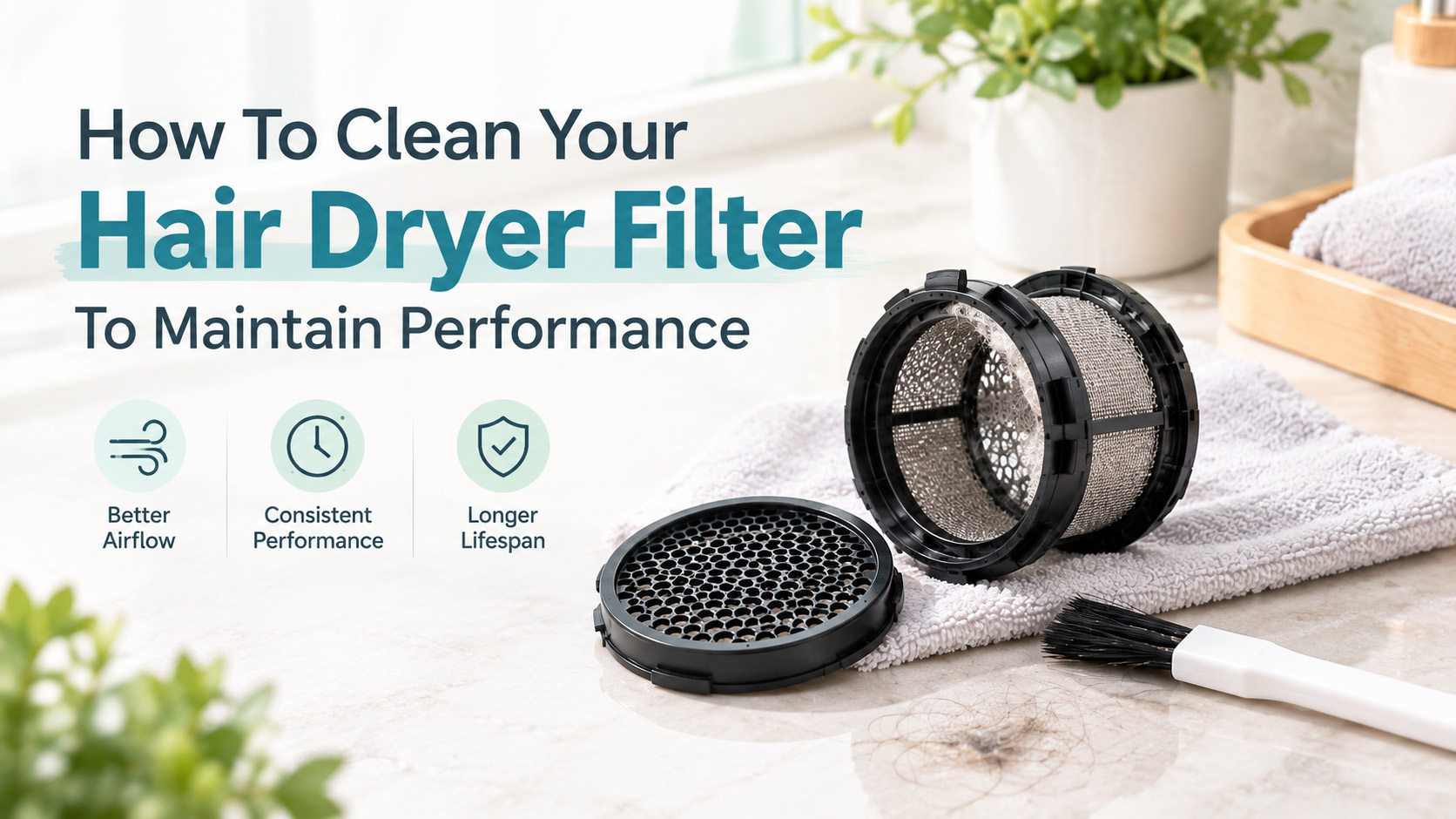
Clean the Filter Regularly
Dust and hair can accumulate around the air intake.
Consumer Reports notes that blocked filters can contribute to overheating and recommends following the manufacturer's maintenance instructions.
You can also read our related guide:
How To Clean Your Hair Dryer Filter To Maintain Performance
Keep the Air Intake Clear
Do not cover the rear air intake while using the dryer.
Keep towels, clothing, bedding, and other materials away from the intake.
Clean Attachments
Remove accumulated hair and styling-product residue from diffusers and concentrator nozzles.
Store It Properly
Allow the dryer to cool before storage.
Keep it in a dry location and avoid unnecessary stress on the power cord.
Common Mistakes When Choosing a Family Hair Dryer
Choosing Only by Wattage
More watts do not automatically mean better overall performance.
Choosing Only by Price
An expensive model may include features your family never uses.
Ignoring Hair Types
A dryer that works well for one person may not work equally well for everyone.
Buying Too Few Settings
A dryer with limited temperature and speed control gives family members fewer options.
Ignoring Attachments
A diffuser can be important for curly hair, while a concentrator can be useful for straightening and precision styling.
Choosing a Heavy Dryer
A powerful but uncomfortable dryer can become frustrating when used every day.
Forgetting Maintenance
Even a high-performance hair dryer needs proper filter and air-intake maintenance.
Frequently Asked Questions
How to chooes A hair dryer for family daily use?
Choose a model with multiple heat and speed settings, strong but adjustable airflow, suitable attachments, comfortable weight, reliable performance, and easy filter maintenance.
For a family, versatility is usually more important than maximum power.
How many heat settings should a family hair dryer have?
At least three heat settings are a practical starting point.
More settings can provide additional control, but the number of settings alone does not determine quality. Consumer Reports recommends at least three temperature settings.
Is a high-wattage hair dryer better for family use?
Not necessarily.
Wattage indicates electrical power, but drying performance also depends on airflow, heat control, motor design, and overall engineering.
What is the best hair dryer for thick and fine hair in the same family?
Look for a model with adjustable airflow and temperature.
The person with thick hair can use stronger airflow, while the person with fine hair can use lower heat and more controlled airflow.
Should a family hair dryer have a diffuser?
If someone in your household has curly or wavy hair, a diffuser can be a very useful attachment.
Is ionic technology necessary for a family hair dryer?
No.
Ionic technology can be useful for certain styling goals, but adjustable heat, airflow, attachments, comfort, and maintenance are more fundamental considerations.
Is a lightweight hair dryer better for everyday family use?
A lightweight and well-balanced model can be more comfortable, particularly when several people use the dryer or drying sessions are long.
How can I reduce hair damage when using a hair dryer every day?
Use lower or medium heat when possible, avoid concentrating hot air on one area for too long, allow hair to partially air dry when practical, and use a suitable heat-protective product. These approaches are consistent with AAD guidance on reducing heat-related hair damage.
Final Thoughts
Learning how to chooes A hair dryer for family daily use is really about finding the right balance between power, control, comfort, versatility, and hair care.
A family hair dryer should not simply be powerful.
It should be adaptable.
Look for adjustable heat and airflow, useful attachments, a comfortable design, reliable motor performance, and easy maintenance. These features allow one hair dryer to accommodate different hair types and different daily routines.
Most importantly, remember that higher heat is not automatically better. Dermatologists recommend limiting excessive heat exposure and using lower or medium settings when possible.
For a household with several different hair types, a versatile hair dryer with good airflow control and multiple temperature options can make everyday styling easier for everyone.

📬 Contact Information
Contact Person: Jenny
Tel / WhatsApp / WeChat: +86 137 1719 2238
Address: No. 12, Donghuan 2nd Road, Huangjiang Town, Dongguan, Guangdong, China
For partnership inquiries, distribution, private label OEM, or large-scale projects, please reach out directly.
Welcome to Hongya!
17+ years OEM/ODMproduction experience.
Main products include: HairDryers, Hot Air Brush, HairStraighteners, Hair Curlers,Hair Straightener Brushes,etc.
20+R&D staff
280+ employees.
15000+ ㎡ factories.
100,000+ PCS MonthlyProduction.
Currently developing200+ products.
Patents/Certifications support Online Query.

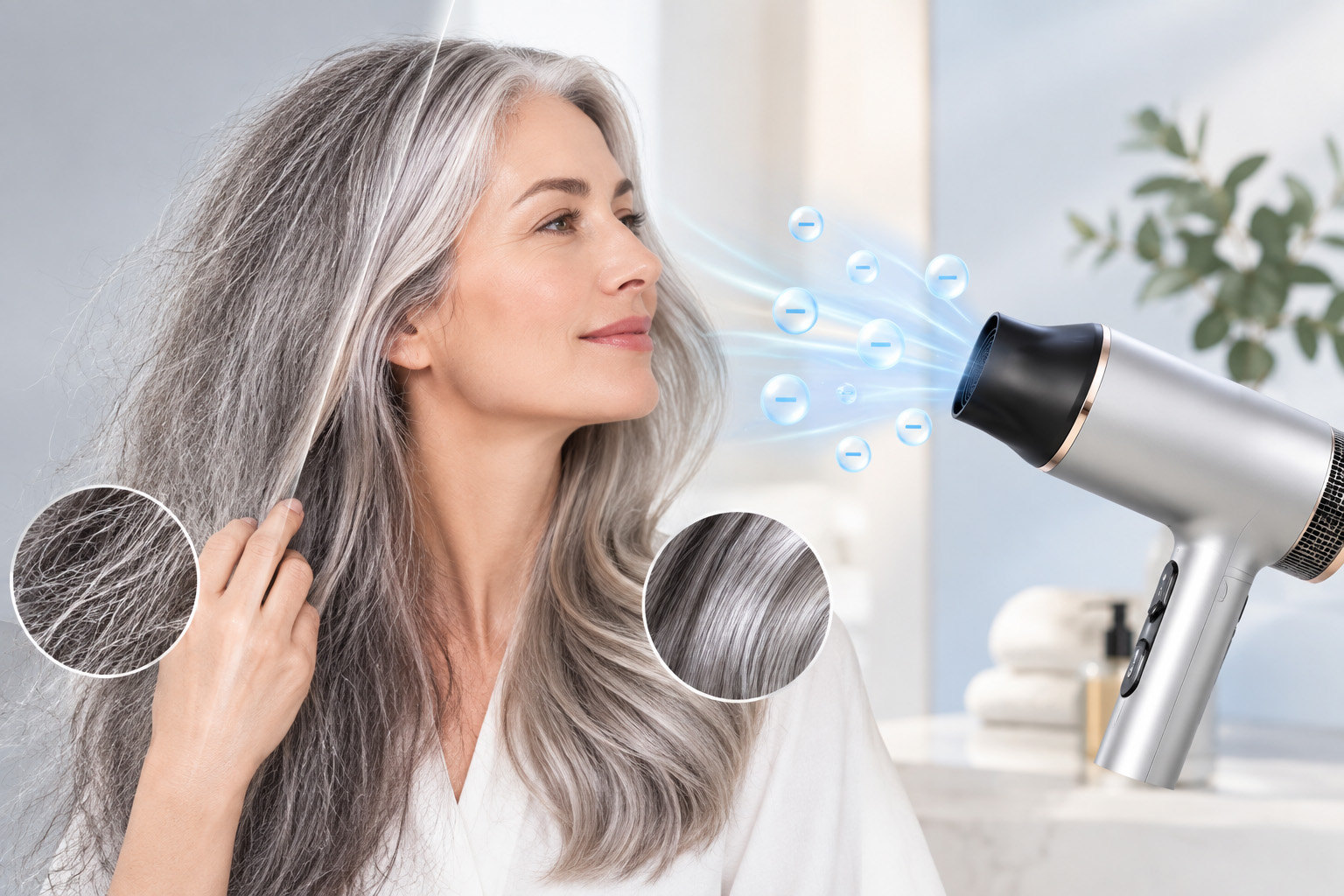
Do Negative Ions Really Work on Grey & Dry Brittle Hair?
Related Article