
Hair Straightening Brush for Thick Hair: Does It Really Work?
Hair Straightening Brush for Thick Hair: Does It Really Work?
Yes, a hair straightening brush can work on thick hair, but the result depends on your hair texture, density, length, and styling goal.
A straightening brush combines heated bristles with gentle tension. It can smooth frizz, loosen waves, reduce puffiness, and create a straighter appearance while preserving some natural volume. For many people with thick or coarse hair, it is faster and easier to use than a traditional flat iron for everyday styling.
However, a hair straightening brush may not produce the same ultra-flat, glass-like finish as a flat iron. Very curly, tightly coiled, or highly resistant hair may require smaller sections, higher heat, a pre-blow-dry, or a flat iron for the final pass.
The short answer is simple: a hair straightening brush is effective for smoothing and straightening thick hair, but it is not a universal replacement for a flat iron.
What Makes Thick Hair Difficult to Straighten?
Thick hair is not always the same as coarse hair. “Thick” usually describes the number of hairs or the overall density, while “coarse” describes the diameter and feel of each strand.
Hair can be:
- Thick and straight
- Thick and wavy
- Thick and curly
- Thick and coarse
- Fine but very dense
Each type reacts differently to heat and tension.
High Hair Density
When hair is dense, heat takes longer to reach every layer. If the sections are too large, the outer strands may look smooth while the hair underneath remains wavy or puffy.
Coarse or Resistant Strands
Coarse hair often needs more controlled heat and slower passes. A low-temperature setting may not provide enough energy to reshape the strand temporarily.
Frizz and Uneven Texture
Thick hair can contain several textures at once. Some sections may be straight, while others are wavy or curly. Humidity, dryness, and damage can also make the finished style look uneven.
Longer Styling Time
A conventional flat iron requires you to clamp each section between two heated plates. On thick hair, this can take time and may require repeated passes. A straightening brush covers more hair during each pass, although it may not create the same level of compression.
How Does a Hair Straightening Brush Work?
A hair straightening brush uses heated bristles to warm the hair while the brush moves through it. The combination of heat, brushing tension, and repeated contact helps relax waves and smooth the outer cuticle layer.
Most designs include:
- A heated brush surface
- Bristles that separate or guide the hair
- An adjustable temperature display or control
- An insulated tip or outer body
- An automatic shut-off function on some models
- A swivel cord or cordless design on some models
The brush works best when it can make consistent contact with the hair without pulling aggressively. It is generally used on dry hair, one small section at a time.
Why the Brush Can Be Useful for Thick Haira
The main advantage is coverage. A brush can move through a wider section of hair than a narrow flat iron, helping reduce styling time for dense hair.
It also creates a softer finish. Instead of pressing the hair completely flat, the brush usually leaves more movement and body near the roots. This can be useful if you want polished hair without losing all of your natural volume.
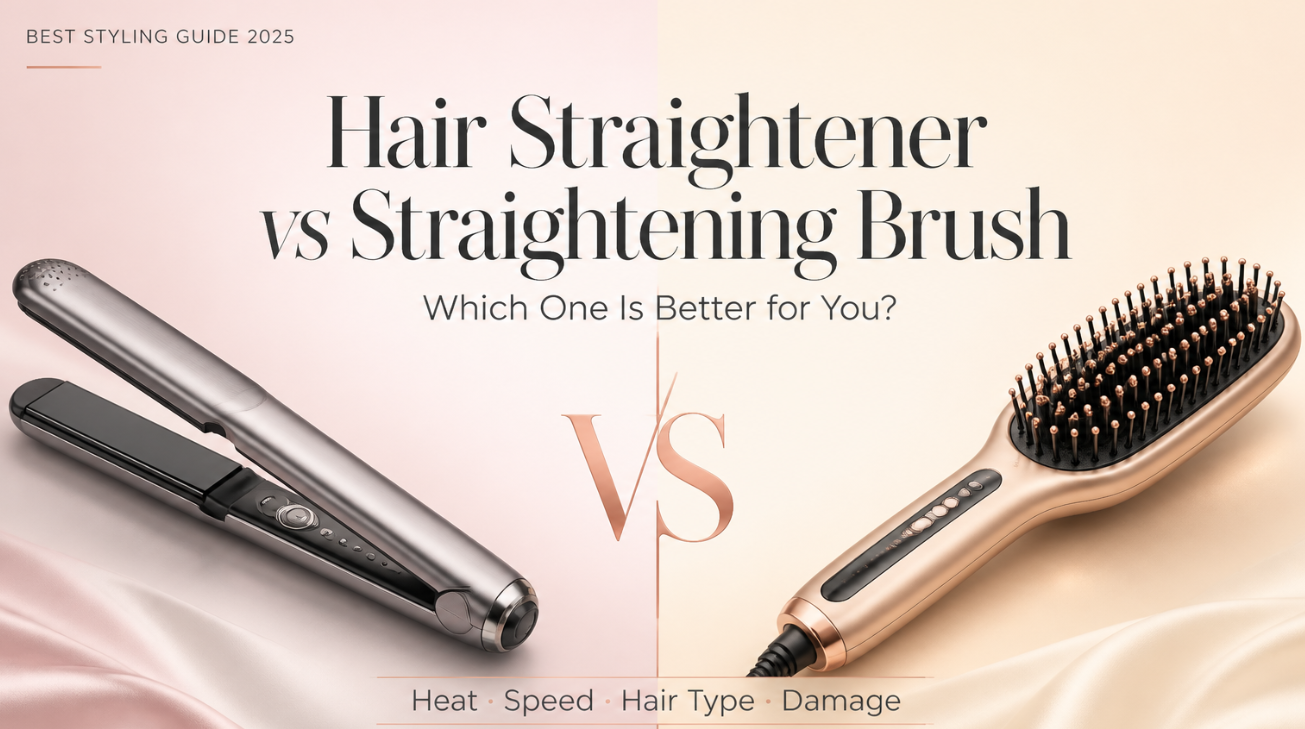
Is a Straightening Brush Better Than a Flat Iron for Thick Hair?
Neither tool is automatically better. The best choice depends on the finish you want and how resistant your hair is.
| Feature | Hair Straightening Brush | Flat Iron |
|---|---|---|
| Main result | Smooth, straighter, natural-looking hair | Very straight, sleek, compressed finish |
| Styling coverage | Larger sections | Smaller sections |
| Ease of use | Similar to brushing hair | Requires more hand control |
| Volume | Usually preserves more volume | Can flatten the hair more |
| Curly hair control | Moderate to good, depending on texture | Stronger control with correct technique |
| Root styling | Can smooth roots without extreme flattening | Can create very flat roots if used carefully |
| Everyday touch-ups | Convenient for many users | Precise but may take longer |
| Best for | Thick, wavy, frizzy, or moderately coarse hair | Very curly, highly resistant, or ultra-sleek styles |

When a Straightening Brush May Be the Better Option
A straightening brush may be a good choice if you want to:
- Smooth thick, wavy hair quickly
- Reduce frizz without making hair completely flat
- Create a soft, natural straight style
- Refresh hair between washes
- Simplify your styling routine
- Avoid the hand coordination required by a flat iron
When a Flat Iron May Be More Effective
A flat iron may be more suitable if you need:
- A very straight finish
- Strong control over tightly curled sections
- Defined ends or detailed styling
- Long-lasting smoothness in highly resistant hair
- Precise work around short layers or the hairline
For some hair types, the most effective routine is to use a straightening brush for the bulk of the hair and a flat iron only on selected sections.
What Temperature Is Best for Thick Hair?
There is no single temperature that is right for everyone. The correct setting depends on strand thickness, curl pattern, chemical processing, dryness, and heat tolerance.
Start at the lowest setting that can create the desired result. Increase the temperature gradually only if the hair remains difficult to smooth.
General Temperature Guidance
- Fine or damaged hair: Use a lower heat setting and limit repeated passes.
- Normal thick hair: Use a medium setting and work in controlled sections.
- Coarse or highly resistant hair: A higher setting may be needed, but use heat protection and avoid holding the brush in one place.
- Chemically treated hair: Follow the care guidance recommended by your stylist or product manufacturer.
The goal is not to use the highest available temperature. Excessive heat can make hair feel dry, brittle, or rough, especially when the same section is styled repeatedly.
How to Use a Hair Straightening Brush on Thick Hair
Correct technique matters as much as the tool itself. Thick hair usually responds better to preparation and sectioning than to simply increasing the temperature.
Step 1: Start with Completely Dry Hair
Do not use a standard heated straightening brush on wet hair unless the product is specifically designed for wet-to-dry styling.
Wet hair is more vulnerable to heat-related damage. Dry your hair fully before using a heated brush, and make sure no damp areas remain underneath the top layer.
Step 2: Apply Heat Protectant
Use a heat protectant suitable for your hair type. Apply it evenly rather than concentrating a large amount on one area.
Allow the product to dry or absorb according to its instructions before applying direct heat.
Step 3: Detangle Before Styling
Remove major knots with a regular detangling brush or wide-tooth comb. A heated straightening brush is designed to smooth hair, not force its way through severe tangles.
Detangling first can reduce pulling and help the heated bristles contact the hair more evenly.
Step 4: Divide Thick Hair into Sections
Separate the hair into at least two or three layers. Very dense hair may need more sections.
Use smaller sections around the crown, roots, and areas that resist straightening. Larger sections can be used on the lower lengths only when the brush can heat them evenly.
Step 5: Brush from Root to End
Place the brush underneath or behind the section, depending on the desired direction. Move steadily from the roots toward the ends.
Avoid stopping on one spot. A slow, controlled pass is usually more effective than repeatedly brushing the same section quickly.
Step 6: Check the Result Before Increasing Heat
After one pass, inspect the section. If it is smoother but not completely straight, try a slower pass or a smaller section before immediately increasing the temperature.
This approach helps minimize unnecessary heat exposure.
Step 7: Finish with a Lightweight Product
If needed, apply a small amount of anti-frizz serum or finishing product to the lengths and ends. Avoid applying heavy product at the roots if you want to preserve volume.
Can a Straightening Brush Straighten Curly or Coarse Thick Hair?
A straightening brush can loosen and smooth curly or coarse thick hair, but results vary significantly.
For loose curls and waves, the brush may create a noticeably straighter finish with good volume. For tight curls or highly resistant strands, it may reduce bulk and frizz without making every section completely straight.
Factors That Affect the Result
- Curl pattern
- Hair porosity
- Strand thickness
- Hair density
- Moisture level
- Previous chemical treatments
- Section size
- Brush temperature
- Speed of each pass
- Humidity after styling
If your hair is tightly curled, a blow-dry with tension before using the brush may improve the result. You may also use a flat iron selectively on sections that need additional definition.
How Long Does Straightening Last on Thick Hair?
The result may last until the hair is exposed to moisture, sweat, humidity, or washing. Thick hair that is naturally wavy or curly may gradually return to its original shape.
A straightening brush does not permanently change the hair structure. It creates a temporary heat-styled effect.
To help the style last longer:
- Make sure the hair is completely dry before styling.
- Avoid using excessive product that attracts moisture.
- Protect the hair from rain and high humidity when possible.
- Sleep on a smooth fabric surface or loosely wrap the hair.
- Use a light anti-humidity or finishing product if it suits your hair.
The exact duration depends on the individual hair type and environment, so claims of a fixed wear time should be treated cautiously.

What Features Should You Look for in the Best Hair Straightening Brush for Thick Hair?
The best hair straightening brush for thick hair should offer enough control to work through dense sections without relying only on maximum heat.
Adjustable Temperature Settings
Multiple temperature settings allow you to match the tool to your hair. This is more practical than a single fixed temperature, especially if your hair includes both delicate and resistant areas.
Even Heat Distribution
Uneven heating can create inconsistent results. Look for a brush designed to maintain stable heat across the active surface.
Bristle Design That Separates Hair
Bristles should guide and separate the hair without excessive pulling. Protective tips may also help reduce direct contact between the hottest surface and the scalp.
Sufficient Brush Surface Area
A wider brush surface may improve coverage on long or dense hair. However, an excessively large brush can make it harder to reach the roots or style shorter layers.
Fast Heat-Up and Clear Controls
A readable temperature display and simple controls make it easier to use the tool consistently. Avoid changing the temperature accidentally while styling.
Safety Features
Automatic shut-off, heat-resistant materials, and a stable resting design are useful safety features. Always follow the manufacturer’s instructions.
Cord Length and Handling
Thick hair may require a longer styling session. A flexible swivel cord, comfortable handle, and manageable weight can make the process easier on the wrist and arm.
Common Mistakes When Using a Straightening Brush on Thick Hair
Using Sections That Are Too Large
If the brush cannot heat the entire section evenly, the result may be smooth on the surface but unfinished underneath.
Moving Too Quickly
Fast brushing may not provide enough contact time. Use a controlled pace rather than rushing through the hair.
Applying Heat to Damp Hair
Unless the product is explicitly designed for wet-to-dry use, avoid applying direct heat to damp hair.
Repeating Passes Without Checking the Section
More passes do not always create a better result. Check the hair after each pass and adjust the section size or technique first.
Ignoring the Roots
The roots often determine whether thick hair looks smooth or puffy. Use smaller sections near the roots, but keep the brush moving and avoid pressing it directly against the scalp.
Choosing Maximum Heat Immediately
High heat may shorten styling time, but it can also increase dryness and damage. Start lower and adjust gradually.
Is a Hair Straightening Brush Safe for Thick Hair?
A hair straightening brush can be used safely when operated correctly, but any heated styling tool can cause burns or heat damage if misused.
Follow these precautions:
- Read the product instructions before first use.
- Use the recommended heat protectant.
- Do not hold the brush in one place.
- Keep the heated surface away from the scalp and skin.
- Do not use the tool near water unless it is rated for that purpose.
- Unplug or power off the brush after use.
- Store it only after it has cooled completely.
- Reduce heat exposure if the hair becomes dry, brittle, or unusually rough.
If your hair is bleached, heavily damaged, or undergoing treatment, consider asking a qualified hairstylist for personalized guidance.
Hair Straightening Brush for Thick Hair: Pros and Cons
Pros
- Covers more hair than a narrow flat iron
- Can reduce frizz and puffiness
- Often preserves more natural volume
- Simple brushing motion may feel intuitive
- Useful for everyday smoothing and touch-ups
- Can create a softer, less compressed finish
Cons
- May not create an ultra-straight result
- Can be less effective on tight curls
- Requires sectioning on very dense hair
- May leave some texture near the roots or ends
- Results can change with humidity
- Still requires heat protection and careful handling
Who Should Choose a Hair Straightening Brush?
A straightening brush may suit you if your main goal is to make thick hair look smoother, more controlled, and less frizzy without completely flattening it.
It is particularly useful for:
- Thick wavy hair
- Dense hair that becomes puffy
- Frizzy hair that needs daily smoothing
- Hair that is already mostly straight
- People who prefer a natural-looking finish
- Quick morning styling and touch-ups
A flat iron may be a better primary tool if your hair is tightly curled and you require a very sleek, uniform result every time.
Frequently Asked Questions
Does a straightening brush work better on thick hair than a flat iron?
It may be faster and easier for smoothing large amounts of thick hair, but a flat iron usually provides stronger compression and a straighter finish. The better tool depends on whether you value speed and volume or maximum sleekness.
What is the best hair straightening brush for thick hair?
The best option should have adjustable temperature settings, even heat distribution, effective bristles, clear controls, and appropriate safety features. Choose based on your hair texture and desired finish rather than relying only on the highest temperature or largest brush head.
Can I use a straightening brush on thick curly hair?
Yes, but the result may be a smoother, stretched style rather than completely straight hair. Use small sections and consider blow-drying with tension first if your curls are highly resistant.
Does a straightening brush damage thick hair?
Any heated tool can contribute to dryness or damage when used at excessive temperatures or too frequently. Heat protectant, controlled passes, fully dry hair, and a suitable temperature can help reduce unnecessary stress.
Should I use a straightening brush on wet hair?
Only if the product is specifically designed and labeled for wet-to-dry use. A standard heated straightening brush should generally be used on completely dry hair.
How many passes should I use on each section?
Use the fewest passes needed to achieve the desired result. If a section is not smoothing, first try making it smaller or moving more slowly instead of immediately increasing the temperature.
Can a straightening brush replace a flat iron?
For loose waves, frizz, and everyday smoothing, it may replace a flat iron for some users. For tight curls, very coarse hair, or an ultra-sleek finish, a flat iron may still be more effective.
Final Verdict: Does a Hair Straightening Brush for Thick Hair Really Work?
Yes, a hair straightening brush for thick hair really can work when the tool and technique match your hair type.
It is most effective for reducing frizz, smoothing waves, controlling volume, and creating a natural-looking straighter style. It may also save time because the brush can cover larger sections than a traditional flat iron.
However, it should not be viewed as a guaranteed replacement for every styling tool. Very curly, tightly coiled, or highly resistant hair may need more preparation or a combination of tools.
The best approach is to choose a brush with adjustable heat, divide thick hair into manageable sections, use heat protection, and focus on controlled technique rather than maximum temperature. When used realistically, a straightening brush can be a practical and versatile option for thick hair.
📬 Contact Information
Contact Person: Jenny
Tel / WhatsApp / WeChat: +86 137 1719 2238
Address: No. 12, Donghuan 2nd Road, Huangjiang Town, Dongguan, Guangdong, China
For partnership inquiries, distribution, private label OEM, or large-scale projects, please reach out directly.
Welcome to Hongya!
17+ years OEM/ODMproduction experience.
Main products include: HairDryers, Hot Air Brush, HairStraighteners, Hair Curlers,Hair Straightener Brushes,etc.
20+R&D staff
280+ employees.
15000+ ㎡ factories.
100,000+ PCS MonthlyProduction.
Currently developing200+ products.
Patents/Certifications support Online Query.

How Does a Steam Hair Straightener Work? Benefits and Styling Tips
Related Article
This guide breaks down the real differences so you can pick the right tool with confidence.