How to Choose a Hair Dryer for Fine, Thin Hair
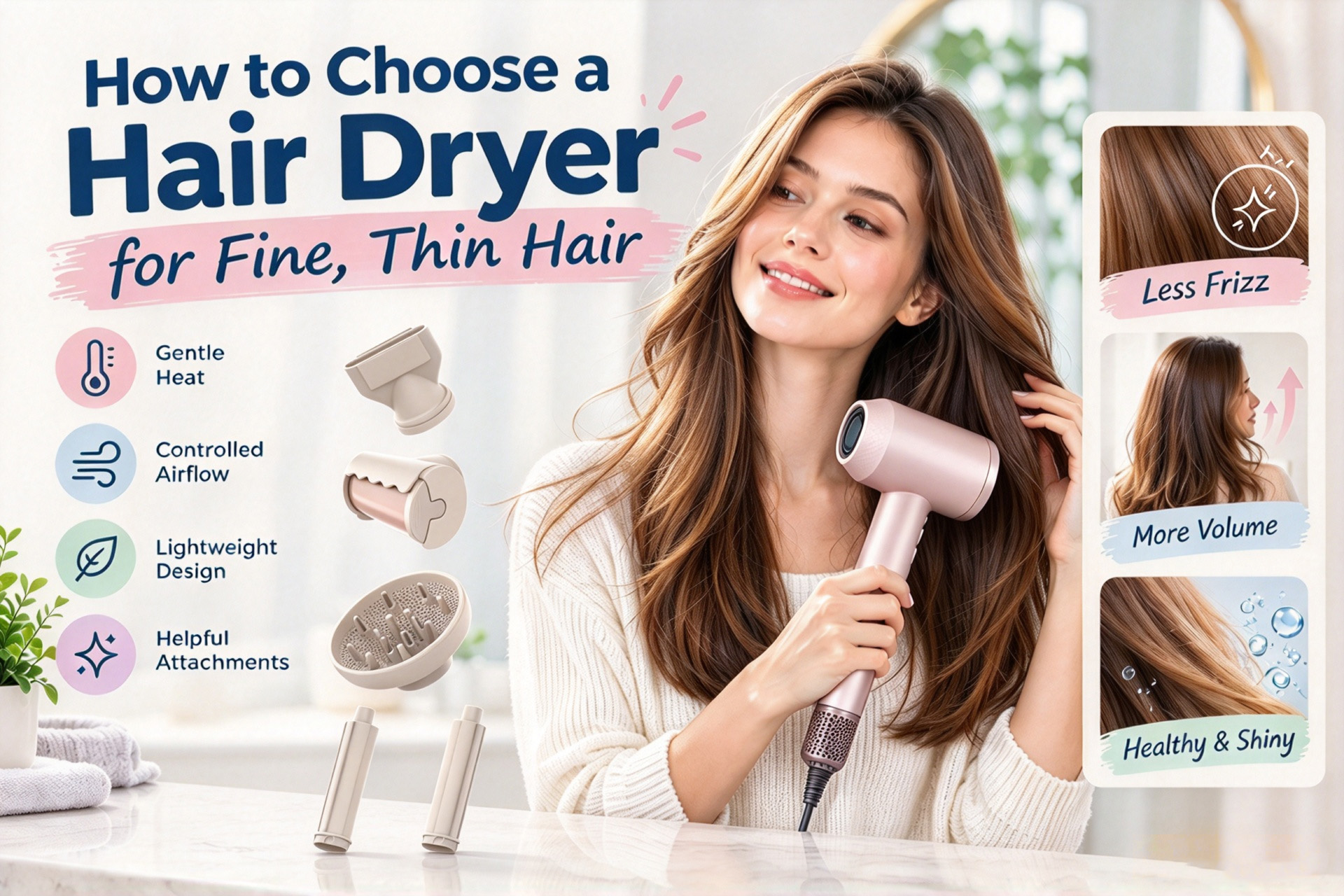
How to Choose a Hair Dryer for Fine, Thin Hair
Finding the right hair dryer can be challenging when your hair is fine, thin, easily flattened, or prone to heat damage. A dryer that works well for thick hair may create too much heat or airflow for fine strands.
So, How to Choose a Hair Dryer for Fine, Thin Hair?
The key is not simply choosing the most powerful hair dryer. Fine, thin hair usually benefits from adjustable heat, controlled airflow, lightweight design, multiple speed settings, and suitable styling attachments.
This guide explains How to Choose a Hair Dryer for Fine, Thin Hair, what features actually matter, which settings to use, how to add volume without excessive heat, and what mistakes to avoid.
Fine Hair vs. Thin Hair: What Is the Difference?
Before learning How to Choose a Hair Dryer for Fine, Thin Hair, it is important to understand that "fine" and "thin" describe different things.
What Is Fine Hair?
Fine hair refers to the diameter of each individual hair strand.
Fine strands are physically smaller and can be more easily weighed down by heavy products or excessive styling.
Fine hair may also lose volume quickly after drying.
What Is Thin Hair?
Thin hair usually refers to lower hair density, meaning there are fewer individual hairs covering the scalp.
You can have:
- Fine but dense hair
- Fine and thin hair
- Thick but low-density hair
- Coarse but dense hair
Therefore, the best hair dryer for fine thin hair should be selected according to both strand thickness and overall hair density.

How to Choose a Hair Dryer for Fine, Thin Hair
1. Choose a Hair Dryer With Multiple Heat Settings
Heat control should be one of your first considerations when choosing a hair dryer for fine hair.
Fine strands can be more sensitive to excessive heat, particularly when the dryer is held close to the hair for an extended period.
Why Low and Medium Heat Matter
A high-temperature setting is not always necessary for fine hair.
For everyday drying, try:
- Low heat: delicate, short, or already dry hair
- Medium heat: normal daily drying
- Higher heat: occasional controlled styling when necessary
A useful hair dryer for fine thin hair should ideally allow you to control heat and airflow separately.
This gives you more flexibility.
For example, you may want:
Lower heat + moderate airflow
instead of automatically using low heat with very weak airflow.
2. Look for Adjustable Airflow
Airflow is another important factor in How to Choose a Hair Dryer for Fine, Thin Hair.
Fine hair does not necessarily need weak airflow.
In fact, controlled airflow can help shorten drying time while giving you more styling control.
High Airflow vs. Controlled Airflow
Very strong airflow can move fine strands around and create unwanted tangling.
Extremely weak airflow can increase drying time.
The ideal option is a dryer with multiple speed settings.
Different speed settings provide different levels of styling control, with lower speeds generally offering more control and higher speeds being useful for quicker rough drying.
For fine thin hair, a useful combination can be:
Medium airflow + low or medium heat
This can provide a balance between drying speed and heat control.
3. Choose a Lightweight Hair Dryer
Weight is often overlooked when choosing a hair dryer.
However, people with fine or thin hair may spend time carefully styling the roots and sections rather than simply blasting the entire head with maximum airflow.
A lightweight hair dryer can make this process more comfortable.
A lighter dryer can make it easier to:
- Lift hair at the roots
- Hold a round brush
- Dry small sections
- Change angles
- Direct airflow precisely
- Finish a complete blowout comfortably
For the best lightweight hair dryer for fine hair, also consider the balance between the motor and handle.
A dryer that is technically lightweight but poorly balanced may still feel uncomfortable.
4. Consider a Concentrator Nozzle
A concentrator nozzle can be particularly useful for fine hair.
Instead of spreading airflow in every direction, the nozzle focuses air onto a smaller section.
This gives you greater styling control.
How to Use a Concentrator on Fine Hair
Attach the concentrator and divide your hair into manageable sections.
Then:
- Start with damp rather than soaking-wet hair.
- Select low or medium heat.
- Use moderate airflow.
- Lift the roots with a round brush or your fingers.
- Direct airflow from the roots toward the ends.
- Keep the dryer moving.
- Finish with cool air if your dryer provides a cool setting.
This technique can help create a smoother finish while maintaining control.
5. Look for a Cool Shot Button
A cool-shot function is useful for finishing a hairstyle.
After shaping a section with warm air, switching to cool air can help cool the hair and finish the styling process.
6. Do Not Choose a Hair Dryer Based Only on Wattage
One of the most common mistakes when learning How to Choose a Hair Dryer for Fine, Thin Hair is assuming that higher wattage automatically means better performance.
It does not.
Wattage indicates electrical power, but actual drying performance also depends on:
- Motor design
- Airflow
- Heating system
- Air outlet design
- Nozzle design
- Temperature control
- Hair length
- Hair density
- Hair moisture
Is a High-Wattage Hair Dryer Good for Fine Hair?
Not necessarily.
For fine hair, controllable performance is often more useful than maximum power.
A powerful dryer can still work well if it provides precise heat and speed control.
7. Consider Ionic Technology Carefully
Ionic hair dryers are often marketed for reducing static and frizz.
Benefits of Ionic Technology
An ionic dryer may be useful if your fine hair tends to have:
- Static
- Flyaways
- Frizz
- A rough-looking finish
A Possible Consideration for Fine Hair
Fine hair can sometimes become too flat when the goal is maximum smoothness.
If your primary goal is volume, you may want to focus more on:
- Adjustable airflow
- Root-lifting technique
- Concentrator attachment
- Cool-shot function
- Lightweight design
Rather than choosing a dryer solely because it has ionic technology.
8. Choose the Right Motor
Motor design affects airflow, noise, weight, and potentially durability.
For fine hair, motor selection should not be based only on maximum power.
Instead, consider whether the motor provides:
- Consistent airflow
- Adjustable speed
- Appropriate heat
- Comfortable operation
- Reasonable noise levels
A well-controlled motor can be more useful than simply choosing the strongest available motor.
9. Choose the Right Hair Dryer Attachment
Attachments can significantly change how a hair dryer behaves.
For fine thin hair, the most useful attachments are often a concentrator and, depending on the hairstyle, a diffuser.
Concentrator Nozzle
Best for:
- Smooth blowouts
- Root lifting
- Controlled airflow
- Straight styles
- Round-brush styling
Diffuser
A diffuser may be useful if you have fine curly or wavy hair.
It spreads airflow across a wider area rather than concentrating strong airflow on one section.
This can help you dry curls while maintaining their shape.
Comb Attachment
A comb attachment can be useful for certain styling routines, particularly when you want to stretch or smooth hair while drying.
The right attachment depends on your hair texture and desired result.
10. Consider Noise and Ergonomics
A hair dryer is a tool you may use several times each week.
Therefore, comfort matters.
Consumer Reports considers factors such as ease of use, noise, weight, temperature, settings, and cord length when evaluating hair dryers.
Important Ergonomic Features
Look for:
- Comfortable handle
- Well-balanced body
- Easy-to-reach buttons
- Lightweight construction
- Manageable cord
- Comfortable grip
- Reasonable noise level
These features can make a noticeable difference during longer styling sessions.
Best Hair Dryer Settings for Fine, Thin Hair
Knowing How to Choose a Hair Dryer for Fine, Thin Hair is only half the solution.
You also need to know how to use it.
| Hair Condition | Heat | Airflow | Recommended Approach |
|---|---|---|---|
| Very fine hair | Low | Low–Medium | Gentle drying |
| Fine straight hair | Low–Medium | Medium | Controlled blow-dry |
| Fine hair needing volume | Low–Medium | Medium | Lift roots while drying |
| Fine wavy hair | Low–Medium | Low–Medium | Use diffuser if needed |
| Fine curly hair | Low–Medium | Low | Diffuser recommended |
| Damp roots | Medium | Medium | Focus on roots |
| Final styling | Cool | Low–Medium | Set the shape |
These are general starting points rather than universal temperature rules. Your hair condition, dryer design, and styling technique should determine the final setting.

How to Dry Fine, Thin Hair Without Damage
The right dryer can help, but your technique is equally important.
Step 1: Remove Excess Water First
Do not immediately use high heat on soaking-wet hair.
Gently remove excess moisture with a towel or soft T-shirt.
Step 2: Apply Heat Protection
If you regularly use heat styling tools, a suitable heat-protective product can be part of your routine.
Do not assume that an ionic, ceramic, or advanced motor makes heat protection unnecessary.
Step 3: Start With Lower Heat
Begin with low or medium heat.
If your hair is drying efficiently, there is no need to increase the temperature.
Step 4: Keep the Dryer Moving
Avoid holding hot airflow on one small section for too long.
Move the dryer continuously.
Consumer Reports recommends drying at an appropriate distance and temperature to limit unnecessary heat exposure.
Step 5: Focus on the Roots for Volume
If your goal is fuller-looking fine hair, do not flatten the roots.
Lift small sections upward while directing airflow toward the root area.
You can also use a round brush to create additional lift.
Step 6: Finish With Cool Air
Once the hairstyle is almost complete, use the cool setting to finish the style.
This avoids adding unnecessary heat at the end of the process.
How to Add Volume to Fine, Thin Hair With a Hair Dryer
One of the biggest reasons people search for the best hair dryer for fine thin hair is volume.
Fine hair can easily lose volume because the strands are lightweight.
Use a Root-Lifting Technique
Separate the hair into sections.
Lift each section away from the scalp while drying the roots.
Avoid pressing the hair tightly against the scalp with the brush.
Use a Round Brush
A small or medium round brush can help shape the roots.
Direct airflow along the hair rather than randomly blowing from different directions.
Finish With Cool Air
After shaping the roots, briefly switch to cool air.
This helps complete the styling process without continuing to expose the hair to heat.
Common Mistakes When Choosing a Hair Dryer for Fine Hair
Choosing Maximum Heat
More heat does not automatically mean faster or better results.
Excessive heat can damage hair, so the AAD recommends low or medium settings when possible.
Choosing the Strongest Airflow
Very strong airflow can make fine strands difficult to control.
Look for adjustable speeds instead.
Ignoring the Weight
A heavy dryer can make precise styling more difficult.
Focusing Only on Ionic Technology
Ionic technology may help with static and frizz, but it does not replace good airflow and temperature control.
Buying Based Only on Wattage
Wattage is only one specification.
Consider the complete airflow and heat-control system.
Holding the Dryer Too Close
Close-range high heat can increase thermal exposure.
Consumer Reports recommends using a medium setting and maintaining an appropriate distance when blow-drying.
Hair Dryer Buying Checklist for Fine, Thin Hair
Before buying, use this checklist:
Essential Features
- At least three heat settings
- Multiple airflow speeds
- Separate heat and speed controls
- Lightweight or well-balanced design
- Cool-shot function
- Concentrator nozzle
- Easy-to-use controls
Useful Additional Features
- Ionic technology
- Brushless motor
- Diffuser compatibility
- Comb attachment
- Digital temperature display
- Removable filter
- Lower noise design
A removable or accessible filter is also useful for maintenance. Consumer Reports notes that clogged filters can restrict airflow and contribute to overheating, so regular filter cleaning is important. 消费者报告
FAQ: How to Choose a Hair Dryer for Fine, Thin Hair
What is the best type of hair dryer for fine, thin hair?
A good hair dryer for fine, thin hair should provide adjustable heat, adjustable airflow, a cool-shot function, and a lightweight or well-balanced design. A concentrator nozzle can also be useful for precise styling.
Is high wattage better for fine hair?
Not necessarily. Wattage indicates electrical power, but drying performance also depends on airflow, motor design, heating technology, and nozzle design. 消费者报告
Is an ionic hair dryer good for fine, thin hair?
It can be useful if your fine hair is prone to static or frizz. However, if your main goal is volume, prioritize adjustable airflow, temperature control, and root-lifting techniques.
What temperature should I use for fine hair?
Start with a low or medium setting and increase it only when necessary. The AAD recommends low or medium heat to reduce excessive heat exposure. 美国皮肤病学会
How can I dry fine hair without making it flat?
Use moderate airflow, avoid flattening the roots, lift small sections while drying, and use a concentrator or round brush for controlled root styling.
Is a lightweight hair dryer better for fine hair?
A lightweight, well-balanced dryer can make precise styling easier and reduce hand fatigue. Weight and ergonomics are useful factors to consider alongside airflow and heat settings. 消费者报告
Should I use a diffuser on fine thin hair?
If your fine hair is curly or wavy, a diffuser can help distribute airflow more gently. If your goal is a smooth blowout, a concentrator may be more appropriate.
Can a hair dryer damage fine hair?
Yes. Fine hair can still be damaged by excessive heat and prolonged heat exposure. Using lower temperatures, maintaining a suitable distance, keeping the dryer moving, and using heat protection can help reduce unnecessary damage.
Final Thoughts: How to Choose a Hair Dryer for Fine, Thin Hair
Understanding How to Choose a Hair Dryer for Fine, Thin Hair is less about finding the most powerful dryer and more about finding the right balance.
For most fine, thin hair routines, prioritize:
Adjustable heat + controlled airflow + lightweight design + useful attachments + comfortable operation.
Ionic technology can be helpful for static and frizz, while a concentrator can improve styling precision. A diffuser can be useful for fine curly or wavy hair.
Most importantly, avoid relying on maximum heat or maximum airflow every time.
A well-designed hair dryer for fine thin hair should give you enough power to dry efficiently while providing the control needed to protect delicate strands and create volume.

📬 Contact Information
Contact Person: Jenny
Tel / WhatsApp / WeChat: +86 137 1719 2238
Address: No. 12, Donghuan 2nd Road, Huangjiang Town, Dongguan, Guangdong, China
For partnership inquiries, distribution, private label OEM, or large-scale projects, please reach out directly.
Welcome to Hongya!
17+ years OEM/ODMproduction experience.
Main products include: HairDryers, Hot Air Brush, HairStraighteners, Hair Curlers,Hair Straightener Brushes,etc.
20+R&D staff
280+ employees.
15000+ ㎡ factories.
100,000+ PCS MonthlyProduction.
Currently developing200+ products.
Patents/Certifications support Online Query.

How to Use a Hair Dryer Without Damaging Your Hair
Ionic Hair Dryer vs Regular Hair Dryer: What’s the Difference?
Related Article
This guide breaks down the real differences so you can pick the right tool with confidence.