110,000 RPM Hair Dryer: What Does High-Speed Motor Technology Mean?
110,000 RPM Hair Dryer: What Does High-Speed Motor Technology Mean?
A 110,000 RPM hair dryer is designed to deliver high-speed airflow through an advanced motor system. But what does 110,000 RPM actually mean, and does a high-speed motor make a hair dryer dry hair faster?
Modern high-speed hair dryers often use brushless DC motors, compact airflow systems, and adjustable heat settings to improve drying performance and styling control. However, motor speed is only one part of the equation. Airflow design, temperature regulation, nozzle structure, and overall product quality also influence the final result.
In this guide, we explain 110,000 RPM hair dryer technology, how a high-speed brushless motor works, what benefits it may offer, and how to choose a high-speed hair dryer for everyday hair care.
What Does 110,000 RPM Mean in a Hair Dryer?
RPM stands for revolutions per minute. It measures how many times a motor's rotating component completes a revolution in one minute.
A 110,000 RPM hair dryer has a motor rated to reach 110,000 revolutions per minute under its specified operating conditions.
This high rotational speed allows manufacturers to design compact motors that drive specialized impellers to generate fast airflow.
How Is a 110,000 RPM Motor Different from a Traditional Hair Dryer Motor?
Traditional hair dryers commonly use conventional motor designs, while many modern high-speed hair dryers use brushless DC (BLDC) motors.
These motor technologies differ in construction, operating speed, control systems, and design requirements.
A high-speed brushless motor can support a smaller and lighter dryer body while delivering strong airflow. However, actual performance depends on the complete motor and airflow system rather than RPM alone.
Why Is 110,000 RPM Becoming a Popular Hair Dryer Specification?
High-speed motor technology has become an important feature in modern hair styling appliances because consumers increasingly want faster drying, lightweight designs, and better control over heat.
A 110,000 RPM hair dryer may offer several potential advantages:
-
High-speed airflow: Supports efficient moisture removal when paired with an optimized impeller and air duct.
-
Compact design: Makes it possible to build a powerful motor into a relatively small housing.
-
Flexible styling: Focused airflow can help users direct air toward specific sections of hair.
-
Responsive control: Electronic motor control can support adjustable airflow settings.
-
Modern product design: High-speed motors can help manufacturers develop lightweight hair dryers for home and travel use.
These benefits depend on the product's engineering, not simply the number printed on its packaging.
How Does a 110,000 RPM High-Speed Hair Dryer Work?
A high-speed hair dryer works by combining motor rotation, airflow generation, and controlled heating.
Instead of relying on heat alone, the appliance uses moving air to help remove moisture from wet hair.
1. The High-Speed Motor Drives the Impeller
The motor powers a rotating impeller, which moves air through the hair dryer.
At high rotational speeds, the impeller can generate a fast-moving stream of air within a compact device.
However, the impeller shape, blade design, internal airflow path, and outlet structure all influence how effectively the motor's energy becomes useful airflow.
2. High-Speed Airflow Helps Remove Moisture
As air passes over wet hair, it helps remove moisture and promotes evaporation.
Strong, well-directed airflow can help shorten drying time, depending on hair length, density, initial moisture level, and the selected heat and speed settings.
This is why a high-speed hair dryer is often designed to balance airflow velocity with appropriate temperature control.
3. Temperature Control Supports More Comfortable Drying
A high-speed motor does not eliminate the need for heat management.
The heating element and temperature-control system determine how warm the air becomes. Some models also use sensors and electronic controls to help regulate temperature.
When choosing a hair dryer, look for adjustable heat and speed settings rather than assuming that a higher RPM automatically means safer drying.
What Is a Brushless Motor Hair Dryer?
A brushless motor hair dryer uses electronic control to operate the motor without the carbon brushes and mechanical commutator found in traditional brushed DC motor designs.
Brushless motors are well suited to many high-speed appliance applications because they can operate at high rotational speeds without continuous brush-to-commutator contact.
How Does Brushless Motor Technology Work?
A brushless DC motor uses electronic switching to control the magnetic fields that rotate the motor's rotor.
This design removes the routine friction and wear associated with carbon brushes in brushed DC motors.
A well-engineered brushless motor system may provide:
-
High rotational speed in a compact design.
-
Precise electronic speed control.
-
Reduced brush-related wear.
-
Good performance when paired with an appropriate impeller and control system.
These characteristics make brushless technology a popular choice for high-speed hair dryers.
Brushless Motor vs. Traditional Motor Hair Dryer
| Feature | High-Speed Brushless Hair Dryer | Traditional Motor Hair Dryer |
|---|---|---|
| Motor design | Electronically controlled brushless motor | Often uses conventional AC or brushed motor technology |
| Rotational speed | May reach approximately 100,000–110,000 RPM or higher, depending on design | Varies widely by motor type |
| Size and weight | Can support compact designs | Depends on motor and housing |
| Speed control | Can support sophisticated electronic control | Depends on the motor and control system |
| Maintenance considerations | No carbon brushes to replace in a brushless design | Some designs have brush-related wear |
| Drying performance | Depends on airflow, heat, and overall design | Depends on airflow, heat, and overall design |
Important: These are general design differences, not guarantees that every brushless dryer will outperform every traditional model.
Does a 110,000 RPM Hair Dryer Dry Hair Faster?
A 110,000 RPM hair dryer can support fast drying, but higher RPM does not automatically guarantee shorter drying time.
The actual result depends on how effectively the complete appliance converts motor speed into useful airflow and controlled heat.
RPM vs. Airflow Speed vs. Drying Time
These three measurements describe different aspects of hair dryer performance.
| Measurement | What It Means | Why It Matters |
|---|---|---|
| RPM | Motor rotational speed | Indicates the motor's operating speed |
| Air velocity | How fast air moves, often measured in m/s | Helps explain the strength and direction of airflow |
| Air volume | The amount of air delivered over time | Indicates how much air reaches the hair |
| Drying time | How long the hair takes to dry under defined conditions | Measures the practical outcome |
For example, two hair dryers may both advertise 110,000 RPM but deliver different airflow because they use different impellers, ducts, and nozzles.
A dryer with a lower RPM may even outperform a higher-RPM model if its airflow system is more efficient.
What Other Factors Affect Hair Drying Speed?
Hair Type and Hair Density
Thick, long, or dense hair generally takes longer to dry than short or fine hair.
The amount of water remaining in the hair also affects drying time.
Airflow Design
The impeller, air inlet, internal duct, and nozzle determine how efficiently air moves through the appliance.
A well-designed airflow system can help the dryer remove moisture without depending entirely on high temperatures.
Heat Settings
Warm air can accelerate evaporation, but excessive heat may contribute to hair damage.
A balanced combination of airflow and adjustable heat is generally more useful than maximum heat alone.
Drying Technique
Sectioning hair, gently removing excess water with a towel, and directing airflow along the hair can improve the drying process.
For practical hair-care guidance, the American Academy of Dermatology recommends reducing excessive heat exposure and using lower heat settings when possible.
What Are the Benefits of a 110,000 RPM Hair Dryer?
A well-designed 110,000 RPM hair dryer may offer several advantages for everyday styling.
1. Efficient Drying Performance
A high-speed motor can support strong airflow in a compact appliance.
When the airflow path is properly designed, this can help remove moisture efficiently and reduce the time needed for drying.
Actual drying speed still varies by model and hair type.
2. Lightweight and Compact Design
High-speed brushless motors can make compact product designs possible.
This can be useful for users who want a lightweight hair dryer that is easier to handle during daily styling.
A lighter design may also reduce arm fatigue during longer styling sessions, depending on the product's balance and handle design.
3. Better Styling Control
A high-speed hair dryer with adjustable airflow and suitable attachments can help users manage different styling tasks.
A concentrator nozzle can direct air toward a specific section, while a diffuser can distribute airflow more gently for curly or wavy hair.
The motor speed alone does not determine styling quality. Attachment design and airflow control also matter.
4. Potentially Less Dependence on Excessive Heat
Some high-speed dryers are designed to combine strong airflow with controlled temperatures.
This approach can help users dry hair efficiently without always selecting the highest heat setting.
However, a 110,000 RPM motor does not automatically prevent heat damage. Proper temperature control and drying technique remain essential.
5. Modern Features for Everyday Use
Depending on the model, a high-speed hair dryer may include:
-
Multiple heat and speed settings.
-
Intelligent temperature monitoring.
-
Ionic technology.
-
Magnetic styling attachments.
-
Removable filters.
-
Compact, ergonomic housing.
These features should be evaluated individually rather than assumed to be included in every 110,000 RPM hair dryer.
Is a 110,000 RPM Hair Dryer Better for Your Hair?
A high-speed hair dryer may offer an effective combination of airflow, convenience, and styling control. However, the motor speed alone cannot determine whether a dryer is better for hair health.
Excessive heat and rough handling can damage hair regardless of the motor technology.
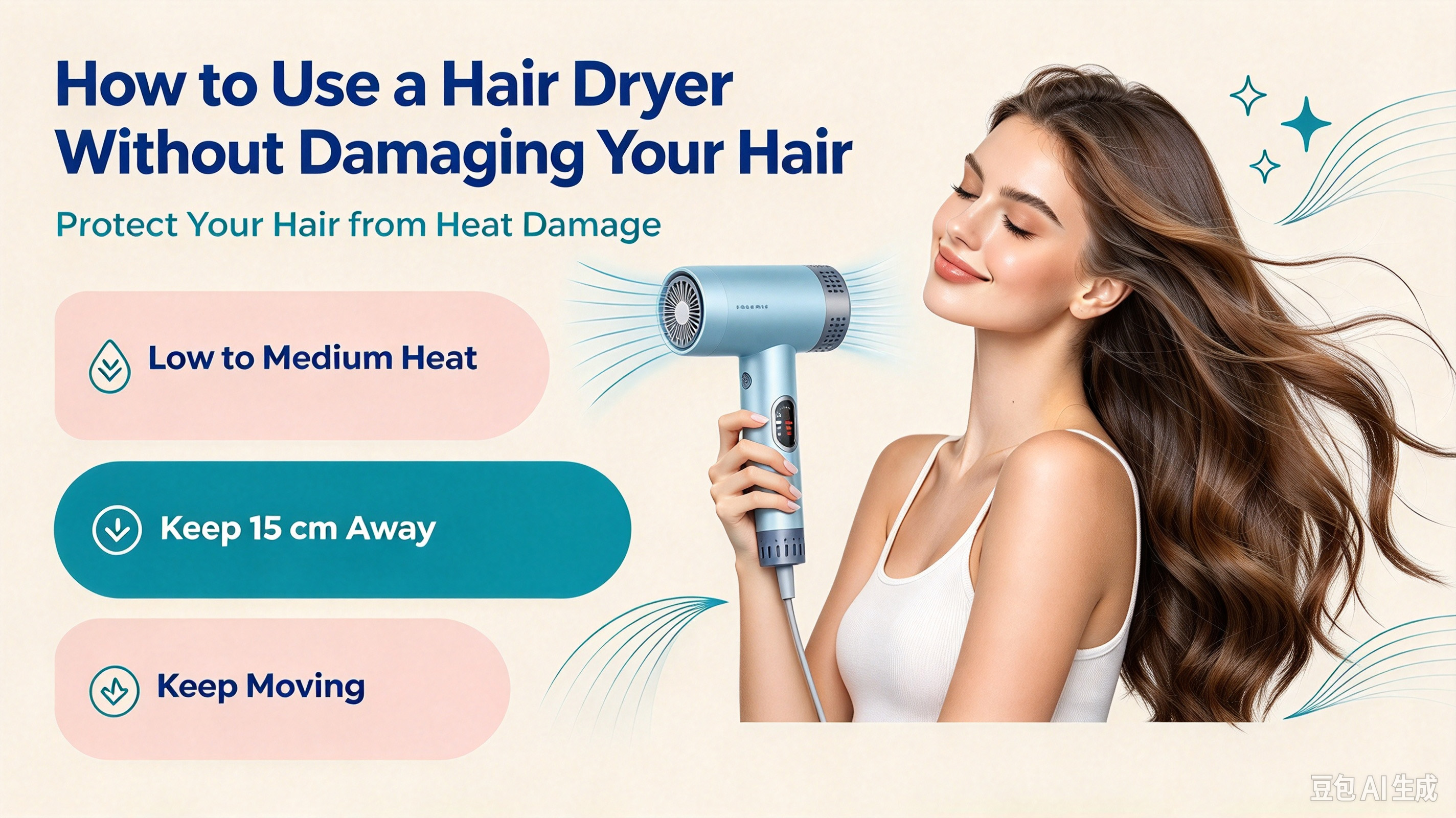
How to Use a High-Speed Hair Dryer Without Excessive Heat Damage
Start with a Lower Heat Setting
Begin with low or medium heat and increase it only when necessary.
Fine, fragile, bleached, or chemically treated hair may benefit from a more conservative heat setting.
Keep the Dryer Moving
Avoid directing hot air at one section for too long.
Move the dryer continuously and adjust the distance according to the manufacturer's instructions.
Use the Right Attachment
Choose a concentrator for targeted styling or a diffuser for curls and waves when compatible with your dryer.
The correct attachment can help you direct or distribute airflow more effectively.
Clean the Air Filter
Dust and hair can accumulate around the air inlet and restrict airflow.
Follow the manufacturer's instructions for cleaning the filter to help maintain performance and reduce the risk of overheating.
Use Heat Protectant When Appropriate
A suitable heat-protection product can be part of a hair-care routine, but it does not make excessive heat harmless.
Combine it with moderate temperatures and careful drying technique.
How to Choose the Best 110,000 RPM Hair Dryer
If you are considering a high-speed hair dryer, compare more than the motor speed printed on the product page.
Check the Most Important Specifications
Air Velocity and Airflow Volume
Look for measured airflow specifications where available.
Compare results only when the measurement methods and test conditions are reasonably consistent.
Motor Type and Quality
Check whether the product uses a brushless motor and whether the manufacturer provides meaningful information about performance, reliability, and testing.
Heat and Speed Settings
Choose a dryer that allows you to adjust temperature and airflow independently, if possible.
This flexibility is useful for different hair types and styling needs.
Weight and Ergonomics
A lightweight dryer with good balance can be more comfortable to use regularly.
Check the total weight, handle shape, button placement, and cord length.
Noise and Vibration
High motor speed does not automatically mean quieter operation.
Look for noise measurements with a stated test distance and method, and consider user reviews where available.
Attachments and Maintenance
Check which attachments are included and whether the air filter is easy to access and clean.
A dryer with suitable attachments and straightforward maintenance may offer better everyday value.
Which Hair Types Can Benefit from a High-Speed Hair Dryer?
| Hair Type | What to Look For | Suggested Approach |
|---|---|---|
| Fine or thin hair | Adjustable heat, lightweight design | Start with low to medium heat |
| Thick or long hair | Strong airflow, suitable concentrator | Use efficient airflow with moderate heat |
| Curly or wavy hair | Compatible diffuser, adjustable speed | Use a diffuser and gentler airflow |
| Damaged or chemically treated hair | Reliable temperature control | Minimize heat exposure |
| Everyday family use | Simple controls, safety features, easy cleaning | Choose a versatile model with multiple settings |
A high-speed hair dryer can be useful across hair types, but the best model is one that matches your hair's needs and your preferred styling routine.
Common Myths About 110,000 RPM Hair Dryers
Myth 1: Higher RPM Always Means Better Performance
Fact: RPM measures motor rotation, not the amount of air that reaches your hair.
Airflow design, temperature control, and product construction all affect performance.
Myth 2: A High-Speed Motor Eliminates Heat Damage
Fact: A high-speed motor does not make hot air harmless.
Excessive heat can still damage hair, so adjustable temperature settings and careful technique matter.
Myth 3: Every 110,000 RPM Hair Dryer Has the Same Performance
Fact: Different products can have different impellers, airflow paths, heating systems, and electronic controls.
A complete performance comparison is more informative than a single RPM figure.
Myth 4: Higher Wattage Always Means Faster Drying
Fact: Wattage measures electrical power consumption, not drying speed by itself.
Airflow efficiency, heat delivery, and the overall design determine how effectively a hair dryer performs.
Frequently Asked Questions About 110,000 RPM Hair Dryers
What does 110,000 RPM mean in a hair dryer?
It means the motor is rated to reach 110,000 revolutions per minute under specified operating conditions. This high rotational speed can support compact motor designs and strong airflow, depending on the rest of the system.
Is a 110,000 RPM hair dryer better than a regular hair dryer?
It can offer advantages in compactness, airflow design, and electronic control. However, performance depends on the motor, impeller, airflow path, temperature regulation, and overall product quality.
Does a 110,000 RPM hair dryer dry hair faster?
It may, but RPM alone cannot confirm drying speed. Compare measured airflow and drying-time results under similar conditions before deciding which model is faster.
Is a brushless motor hair dryer worth buying?
A brushless motor hair dryer may be worth considering if you value compact design, high-speed operation, and electronic speed control. Compare price, airflow, temperature settings, weight, noise, and warranty before buying.
Can a high-speed hair dryer reduce heat damage?
A well-designed model with effective airflow and temperature control may help reduce reliance on excessive heat. Nevertheless, no motor speed guarantees damage-free drying.
What should I look for besides 110,000 RPM?
Look for airflow measurements, adjustable heat and speed settings, temperature regulation, weight, noise information, attachments, filter maintenance, safety features, and warranty coverage.
Is a 110,000 RPM hair dryer suitable for daily use?
It can be suitable for daily use if the product is designed for regular operation and used according to the manufacturer's instructions. Select an appropriate heat setting and avoid prolonged exposure to hot air.
Final Thoughts: Is 110,000 RPM Hair Dryer Technology Worth It?
A 110,000 RPM hair dryer represents a high-speed motor design that can support strong airflow, compact construction, and flexible styling control.
The real value of high-speed motor technology depends on how well the motor works with the impeller, airflow path, heating system, and temperature controls.
When comparing high-speed hair dryers, do not focus on RPM alone. Evaluate airflow, drying performance, heat regulation, ergonomics, maintenance, and product reliability together.
For consumers, the best high-speed hair dryer is not necessarily the one with the highest specification. It is the one that delivers the right balance of efficient drying, comfortable handling, and appropriate heat control for your hair.
📬 Contact Information
Contact Person: Jenny
Tel / WhatsApp / WeChat: +86 137 1719 2238
Address: No. 12, Donghuan 2nd Road, Huangjiang Town, Dongguan, Guangdong, China
For partnership inquiries, distribution, private label OEM, or large-scale projects, please reach out directly.
Welcome to Hongya!
17+ years OEM/ODMproduction experience.
Main products include: HairDryers, Hot Air Brush, HairStraighteners, Hair Curlers,Hair Straightener Brushes,etc.
20+R&D staff
280+ employees.
15000+ ㎡ factories.
100,000+ PCS MonthlyProduction.
Currently developing200+ products.
Patents/Certifications support Online Query.

Hair Straightener vs Straightening Brush: Which One Is Better for You?
How Hot Should a Hair Dryer Be? Understanding Safe Heat Settings
Related Article

This guide breaks down the real differences so you can pick the right tool with confidence.