How Hot Should Your Hair Dryer Air Temperature Be?
How Hot Should Your Hair Dryer Air Temperature Be?
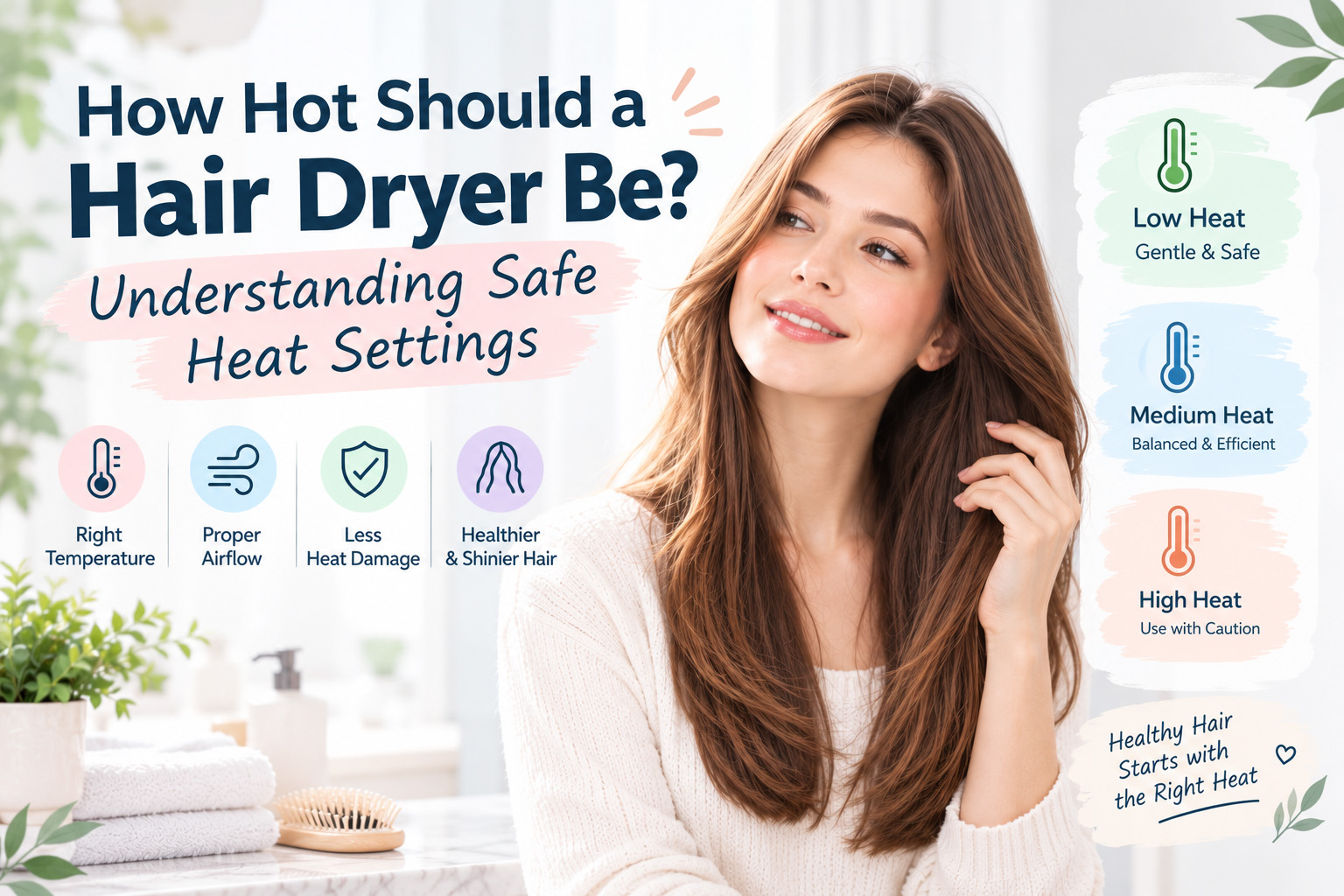
How hot should your hair dryer air temperature be? This is one of the most important questions to ask if you regularly blow-dry your hair.
A hair dryer that is too hot can contribute to dryness, roughness, frizz, and damage to the hair cuticle. On the other hand, using only cool air for a long time may make drying unnecessarily slow.
So, How Hot Should Your Hair Dryer Air Temperature Be? Safe Heat Range is not simply about finding the highest or lowest temperature. The better approach is to balance air temperature, airflow, drying distance, exposure time, and hair type.
In this guide, we explain the practical safe heat range for hair dryers, how hot a hair dryer should be for different hair types, how far away you should hold the dryer, and how to reduce heat damage while still achieving fast, smooth results.

How Hot Should Your Hair Dryer Air Temperature Be?
There is no single temperature that is universally "safe" for every person or every hair dryer.
The temperature that actually reaches your hair depends on the dryer setting, airflow, distance from the hair, how long the air is applied, and the design of the dryer.
A useful practical target is to keep the air reaching the hair around 40–60°C (104–140°F) for routine drying, while avoiding prolonged exposure to very high temperatures.
Research on hair-dryer use found that hair exposed to 47°C at a 15 cm distance experienced less surface damage than hair exposed to 61°C at 10 cm or 95°C at 5 cm. The study also found that hair-surface damage increased as temperature increased.
This means that distance and movement are just as important as the temperature setting.
A Practical Hair Dryer Temperature Guide
| Hair Dryer Air Temperature | General Use | Recommendation |
|---|---|---|
| 30–40°C / 86–104°F | Gentle drying | Excellent for delicate or damaged hair |
| 40–50°C / 104–122°F | Everyday drying | Good practical range |
| 50–60°C / 122–140°F | Faster drying | Suitable with controlled exposure |
| 60–70°C / 140–158°F | Stronger heat | Use carefully and keep the dryer moving |
| 70°C+ / 158°F+ | Very hot | Avoid prolonged direct exposure |
| 90°C+ / 194°F+ | Extreme surface heat | High risk of heat-related hair damage |
Important: These are practical guidance ranges rather than a universal medical "safe limit." Hair dryers differ considerably, and the temperature at the nozzle can be much higher than the temperature actually reaching the hair.
Why Hair Dryer Temperature Matters
Hair is made primarily of keratin, and its outer cuticle acts as a protective layer.
Repeated exposure to excessive heat can affect the cuticle and contribute to changes in hair texture.
A controlled study examining repeated hair-dryer treatments found increasingly obvious cuticle damage as the temperature increased from 47°C to 61°C and then 95°C.
Another recent study found lifted cuticles in hair subjected to repeated high-heat drying conditions, reinforcing the importance of controlling heat during regular blow-drying.
This is why the answer to How Hot Should Your Hair Dryer Air Temperature Be? Safe Heat Range should always include more than just the number shown on a dryer.
Temperature Is Only One Part of Heat Exposure
The total heat exposure depends on:
- Air temperature
- Distance from the hair
- Airflow speed
- Drying time
- Hair moisture
- Number of drying sessions
- Hair condition
- Whether the dryer remains in one position
For example, a moderately warm airflow moving continuously may be less damaging than extremely hot air concentrated on one small section.
What Is the Safe Heat Range for a Hair Dryer?
For regular home hair drying, a moderate air temperature around 40–60°C (104–140°F) at the hair surface is a useful practical target.
The lower end is preferable when:
- Hair is fine
- Hair is bleached
- Hair is chemically treated
- Hair is already dry or brittle
- You are drying the same area for a long time
The higher end may be useful when:
- Hair is thick
- Hair is very wet
- You need faster drying
- You are using controlled airflow
- The dryer is kept moving
The key principle is simple:
Use the lowest effective heat that allows you to dry your hair efficiently.
Is 60°C Too Hot for Hair?
Not necessarily.
A hair-dryer study specifically examined drying at approximately 47°C and 61°C at different distances. The higher temperature produced more cuticle damage than the lower temperature, while the highest tested condition—95°C at 5 cm—produced the most severe surface damage.
Therefore, 60°C should not be treated as an automatic "danger temperature."
Instead, consider how long the hair is exposed and how close the dryer is.
How Hot Should Your Hair Dryer Be for Different Hair Types?
Different hair types respond differently to heat.
A temperature that works well for thick hair may be unnecessarily hot for fine or chemically treated hair.
Fine or Thin Hair
Fine hair generally benefits from lower heat.
Recommended Approach
Try:
- Low-to-medium heat
- Low-to-medium airflow
- Greater drying distance
- Continuous dryer movement
- Heat protectant
Fine hair can dry relatively quickly, so there is often little reason to use maximum heat.
Why Lower Heat Is Better
Fine hair has less physical mass and can become overheated more quickly.
A gentle setting can provide sufficient drying performance without unnecessary thermal exposure.
Thick or Long Hair
Thick hair can take considerably longer to dry.
This is where a high-speed hair dryer with adjustable temperature and airflow can be particularly useful.
Recommended Approach
Try:
- Medium heat
- Medium-to-high airflow
- Sectioning the hair
- Keeping the dryer moving
- Using a concentrator when appropriate
Instead of simply increasing temperature, increasing airflow can be a more efficient way to accelerate drying.
Why Airflow Matters
The purpose of a hair dryer is to remove water.
You do not necessarily need extremely hot air to accomplish this.
A well-designed dryer with strong airflow can remove moisture efficiently while allowing the user to maintain moderate heat.
Curly Hair: How Hot Should Your Hair Dryer Be?
Curly and wavy hair often benefits from controlled heat and airflow.
High heat combined with aggressive airflow can disrupt curl patterns and contribute to frizz.
Recommended Settings for Curly Hair
Try:
- Low-to-medium heat
- Low airflow
- Diffuser attachment
- Continuous movement
- Heat protectant
A diffuser helps spread airflow over a larger area instead of concentrating a powerful stream directly onto individual curls.
Avoid Over-Drying Curly Hair
Curly hair can look dry and frizzy when too much heat is used.
Do not keep the diffuser in one position for too long.
Instead, move gradually around the head and reduce the heat as the hair becomes drier.
How Hot Should Your Hair Dryer Be for Damaged or Bleached Hair?
If your hair has been bleached, colored, chemically treated, or is already brittle, a more conservative approach is recommended.
Use:
- Low heat
- Moderate airflow
- Greater distance
- Shorter heat exposure
- Heat protectant
Avoid trying to dry chemically treated hair as quickly as possible with maximum temperature.
The objective should be controlled drying rather than maximum heat.
How Far Should You Hold a Hair Dryer From Your Hair?
Distance has a surprisingly large effect on the temperature reaching the hair.
A study examining hair-dryer exposure measured approximately:
- 47°C at 15 cm
- 61°C at 10 cm
- 95°C at 5 cm
The researchers found increasing hair-surface damage as the temperature increased.
A Good Starting Distance
For everyday drying, keeping the dryer approximately 15 cm (about 6 inches) away from the hair is a useful starting point.
Do not treat 15 cm as a magical universal safety distance. Different dryers have different airflow and temperature characteristics.
Instead, use it as a practical guideline and adjust based on comfort and drying performance.
Keep the Dryer Moving
Never leave very hot airflow focused on one small section for an extended period.
Move the dryer continuously across the hair.
This distributes heat more evenly and reduces localized overheating.
Hair Dryer Temperature vs. Hair Dryer Setting
One common mistake is assuming that "High," "Medium," and "Low" correspond to specific temperatures.
They do not.
A High setting on one hair dryer may produce a very different air temperature from a High setting on another model.
That is why product specifications should ideally distinguish between:
- Heat settings
- Airflow settings
- Temperature control
- Maximum outlet temperature
- Temperature stability
For consumers and manufacturers, intelligent temperature control can be a valuable feature because it provides more consistent heat management during styling.
Does Higher Hair Dryer Temperature Mean Faster Drying?
Not always.
Higher heat can increase drying speed, but airflow plays a major role.
A high-performance dryer with strong airflow can often dry hair efficiently without relying entirely on extreme temperatures.
High Airflow + Moderate Heat
For many users, this is a better combination than:
Very high heat + weak airflow
The first approach focuses on efficiently moving moisture away from the hair.
The second can expose the hair to unnecessary thermal stress.
Look for Adjustable Airflow
A good modern hair dryer should ideally offer several airflow levels.
This allows you to customize the drying process according to:
- Hair thickness
- Hair length
- Curl pattern
- Moisture level
- Styling technique
How to Use a Hair Dryer Without Damaging Your Hair
Temperature control is important, but technique matters just as much.
Step 1: Remove Excess Water First
Do not immediately blast soaking-wet hair with high heat.
Gently squeeze out excess water and use a soft towel or microfiber towel.
Avoid aggressive rubbing because wet hair is more vulnerable to mechanical damage.
Step 2: Apply Heat Protectant
Before blow-drying, apply an appropriate heat-protection product according to its instructions.
This should be part of your routine if you frequently use heat styling tools.
Step 3: Start With Lower Heat
Begin with a lower or medium setting.
If the hair is still very wet, use airflow to help remove moisture rather than immediately increasing temperature.
Step 4: Keep the Dryer Moving
Move the dryer continuously.
Avoid concentrating hot air on one section.
Step 5: Maintain Distance
Keep the dryer away from the hair rather than pressing the nozzle directly against it.
Approximately 15 cm is a useful starting point for routine drying, based on experimental evidence.
Step 6: Reduce Heat Near the End
Once the hair is mostly dry, lower the temperature.
There is little benefit in continuing with maximum heat when only a small amount of moisture remains.
Step 7: Finish With Cool Air
If your dryer has a cool-shot function, use cool air at the end of styling.
This can help finish the hairstyle without adding unnecessary heat.
Can a Hair Dryer Burn Your Hair or Skin?
Yes.
Hair dryers can become hot enough to cause burns, particularly when the hot airflow is held close to the skin for an extended period.
Clinical reports have documented hair-dryer burns, and experimental testing has shown that some dryers can generate very high temperatures at their highest settings.
Therefore:
- Never hold very hot airflow against your scalp.
- Do not use a damaged dryer.
- Keep hot airflow away from children.
- Stop if the heat becomes uncomfortable.
- Follow the manufacturer's safety instructions.
"Safe heat range" does not mean that a particular temperature is guaranteed to be safe for skin or hair in every situation.
Hair Dryer Temperature Chart: Quick Reference
| Hair Type | Suggested Heat | Airflow | Key Tip |
|---|---|---|---|
| Fine hair | Low | Low–Medium | Avoid prolonged heat |
| Normal hair | Low–Medium | Medium | Keep dryer moving |
| Thick hair | Medium | Medium–High | Use airflow to speed drying |
| Curly hair | Low–Medium | Low | Use a diffuser |
| Bleached hair | Low | Low–Medium | Prioritize heat protection |
| Damaged hair | Low | Low–Medium | Minimize heat exposure |
| Long hair | Medium | Medium–High | Dry in sections |
| Coarse hair | Medium | Medium–High | Avoid maximum heat continuously |
These are starting points, not fixed rules.
Your ideal settings depend on the dryer, hair condition, styling product, humidity, and drying technique.

How to Choose a Hair Dryer With Safe Temperature Control
If heat protection is important to you, look beyond wattage.
Multiple Heat Settings
A dryer with several heat levels provides greater flexibility.
Multiple Airflow Settings
Adjustable airflow allows you to increase drying speed without necessarily increasing temperature.
Intelligent Temperature Control
Temperature-sensing technology can help maintain more consistent heat during use.
This can be particularly useful for consumers who frequently blow-dry their hair.
Cool-Shot Function
A cool-air setting provides a useful finishing option and reduces unnecessary heat exposure.
Diffuser Compatibility
For curly and wavy hair, a diffuser can help distribute airflow more evenly.
Concentrator Attachment
A concentrator provides more focused airflow and can be useful for controlled blowouts and smoothing.
Is 60°C a Safe Hair Dryer Temperature?
Around 60°C (140°F) can be a reasonable practical range for controlled drying, particularly when the dryer is kept moving and is not held extremely close to the hair.
However, it should not be interpreted as a guaranteed damage-free temperature.
Research comparing 47°C, 61°C, and 95°C found that hair-surface damage increased as temperature increased.
Therefore, if your hair is fine, damaged, bleached, or dry, starting at a lower temperature is generally the more conservative choice.
Frequently Asked Questions About Hair Dryer Temperature
How Hot Should Your Hair Dryer Air Temperature Be?
For routine drying, a practical target is approximately 40–60°C (104–140°F) at the hair surface, with lower temperatures preferred for fragile or chemically treated hair.
The dryer should also be kept at a reasonable distance and continuously moved.
What Is the Safest Temperature for a Hair Dryer?
There is no single universally safe temperature.
A moderate temperature combined with adequate distance, controlled airflow, and continuous movement is generally a better strategy than using maximum heat.
Is 70°C Too Hot for a Hair Dryer?
70°C (158°F) is relatively hot for direct, prolonged exposure.
If using a setting that produces this level of heat at the hair surface, keep the dryer moving, increase the distance, and minimize exposure time.
Is 100°C Too Hot for Hair?
For prolonged direct exposure, 100°C is extremely hot and should be avoided.
Experimental research found significant surface damage under a 95°C drying condition at close range.
Does Cold Air Damage Hair?
Cold or room-temperature air does not create the same thermal exposure as hot air.
However, very long drying times can still involve mechanical handling and prolonged wetness, so the goal is not necessarily to use cold air exclusively.
Is It Better to Use High Heat or High Airflow?
For many hair types, increasing airflow can be preferable to continuously increasing heat.
Strong airflow can help remove moisture while moderate heat reduces thermal exposure.
How Far Should a Hair Dryer Be From Your Hair?
Approximately 15 cm (6 inches) is a useful starting point for everyday drying.
A controlled study found that drying at 15 cm with continuous movement caused less hair-surface damage than closer, hotter drying conditions.
Final Verdict: How Hot Should Your Hair Dryer Air Temperature Be? Safe Heat Range
So, How Hot Should Your Hair Dryer Air Temperature Be? Safe Heat Range?
The answer is less about finding one perfect number and more about controlling the entire drying process.
For everyday use, around 40–60°C (104–140°F) at the hair surface is a practical range to work within, while lower temperatures are preferable for fine, damaged, bleached, or chemically treated hair.
Remember these five principles:
1. Use moderate heat.
Avoid maximum heat whenever it is unnecessary.
2. Keep the dryer moving.
Do not concentrate hot air on one area.
3. Maintain distance.
Around 15 cm is a useful starting point for routine drying.
4. Use airflow intelligently.
Strong airflow can help reduce drying time without relying entirely on extreme heat.
5. Protect your hair before styling.
Use appropriate heat protection and adjust the temperature according to your hair's condition.
Ultimately, the best hair dryer temperature for healthy-looking hair is the lowest effective heat that dries your hair efficiently without creating excessive thermal exposure.

📬 Contact Information
Contact Person: Jenny
Tel / WhatsApp / WeChat: +86 137 1719 2238
Address: No.27, Bei'an South Road. HuangjiangTown,Dongguan city
For partnership inquiries, distribution, private label OEM, or large-scale projects, please reach out directly.
Welcome to Hongya!
17+ years OEM/ODMproduction experience.
Main products include: HairDryers, Hot Air Brush, HairStraighteners, Hair Curlers,Hair Straightener Brushes,etc.
20+R&D staff
280+ employees.
15000+ ㎡ factories.
100,000+ PCS MonthlyProduction.
Currently developing200+ products.
Patents/Certifications support Online Query.

Lightweight Hair Dryer Problem & How To Extend Service Life
Salon Grade Hair Dryer vs Household Hair Dryer | Who should Buy It
Related Article
This guide breaks down the real differences so you can pick the right tool with confidence.