Infrared Hair Dryer Benefits: Is Far-Infrared Hair Care Worth It?
Infrared Hair Dryer Benefits: Is Far-Infrared Hair Care Worth It?
When choosing a new hair dryer, consumers often see terms such as infrared hair dryer, far-infrared hair dryer, infrared hair care, and gentle heat technology.
But what do these technologies actually mean?
More importantly, are the Infrared Hair Dryer Benefits: Is Far-Infrared Hair Care Worth It claims supported by real differences in hair-drying performance?
An infrared hair dryer uses infrared radiation as part of its heating system or heat-delivery design. Far-infrared technology is often promoted as a way to distribute heat more evenly and potentially reduce excessive surface heating.
However, an infrared hair dryer is not automatically healthier for every type of hair. Drying technique, temperature, airflow, distance from the hair, and exposure time remain extremely important.
This guide explains the potential Infrared Hair Dryer Benefits, how far-infrared hair care works, what the technology can and cannot do, and whether a far-infrared hair dryer is worth considering for your daily hair-care routine.

What Is an Infrared Hair Dryer?
An infrared hair dryer is a hair-drying appliance that incorporates infrared radiation into its heating or heat-transfer system.
Unlike conventional heating that primarily relies on heated air moving across the hair, infrared technology uses infrared energy to transfer heat.
Different products use different infrared technologies, so the term infrared hair dryer does not necessarily describe one standardized heating method.
Some models combine infrared heating with:
- High-speed airflow
- Ceramic heating elements
- Ionic technology
- Temperature sensors
- Multiple heat settings
- Multiple airflow settings
- Concentrator nozzles
- Diffuser attachments
This means consumers should evaluate the complete heating and airflow system rather than choosing a product based only on the word "infrared."
How Does Far-Infrared Hair Care Work?
To understand Infrared Hair Dryer Benefits: Is Far-Infrared Hair Care Worth It, it helps to understand what infrared radiation does.
Infrared radiation is part of the electromagnetic spectrum and is commonly experienced as thermal radiation.
A far-infrared hair dryer is designed to use longer-wavelength infrared energy as part of its heating process.
Does Far-Infrared Heat Hair Differently?
Potentially, yes.
Infrared heating can transfer thermal energy directly to surfaces that absorb the radiation. In a hair dryer, the overall result depends heavily on the specific heating element, airflow design, distance, temperature, and exposure time.
What About "Deep Penetration"?
This is one of the most common claims associated with far-infrared hair care.
Some marketing materials describe far-infrared energy as penetrating deeper into the hair shaft and drying moisture from the inside.
However, consumers should be cautious about interpreting this literally.
Hair is a complex biological fiber, and the actual heating and moisture movement process depends on many factors. A far-infrared dryer should not be assumed to dry the interior of every hair strand uniformly simply because it uses infrared technology.
The more practical question is whether the dryer can provide efficient and controlled heat without unnecessarily overheating the hair surface.
Infrared Hair Dryer Benefits: What Are the Potential Advantages?
The potential benefits of an infrared hair dryer are mainly related to heat distribution, drying efficiency, and temperature control.
However, performance varies significantly between products.
1. Potentially More Even Heat Distribution
One potential benefit of infrared heating is more direct thermal energy transfer.
When heat is distributed more evenly, some areas of the hair may be less likely to receive excessive localized heat.
This can be particularly useful when combined with good airflow and appropriate temperature settings.
Why Even Heat Matters
Hair can become damaged by excessive heat exposure.
High temperatures can affect the hair cuticle and contribute to dryness, roughness, and breakage when exposure is excessive.
Therefore, the goal of a good hair dryer should not simply be "hotter."
The goal should be:
Efficient drying + controlled temperature + sufficient airflow.
2. Potentially Faster Drying
Another frequently discussed infrared hair dryer benefit is faster drying.
If the heating system transfers thermal energy efficiently and the motor provides strong airflow, moisture can evaporate more efficiently.
However, drying speed is not determined by infrared technology alone.
It also depends on:
- Airflow speed
- Air temperature
- Motor performance
- Hair thickness
- Hair length
- Hair density
- Starting moisture level
- Nozzle design
- Drying technique
A powerful conventional hair dryer may therefore dry hair faster than a poorly designed infrared dryer.
3. May Help Reduce Excessive Surface Heating
One of the most interesting potential benefits of infrared technology is heat distribution.
If heat reaches the hair more evenly, users may not need to rely on extremely high surface temperatures to achieve effective drying.
This can potentially make controlled drying easier.
However, infrared technology does not eliminate heat damage.
A far-infrared hair dryer can still damage hair if used at excessive temperatures for too long.
4. May Provide a More Comfortable Drying Experience
Some infrared hair dryers are designed to provide more controlled and consistent warmth.
This can make the drying experience feel less harsh compared with a dryer that produces very concentrated hot air.
Comfort depends on the entire product design, including:
- Temperature stability
- Airflow
- Nozzle design
- Motor vibration
- Handle ergonomics
- Weight
- Noise level
Therefore, Infrared Hair Dryer Benefits: Is Far-Infrared Hair Care Worth It should be evaluated as a complete product experience rather than infrared technology alone.
5. Can Be Combined With Other Hair-Dryer Technologies
Infrared heating does not have to work alone.
Many modern hair dryers combine several technologies.
Infrared + Ionic Technology
An infrared ionic hair dryer combines infrared heating with ion generation.
Ionic technology is commonly marketed for helping reduce static and improve the appearance of frizz.
The two technologies address different aspects of the drying process.
Infrared technology focuses primarily on heat transfer.
Ionic technology focuses more on the interaction between ions, water droplets, and static electricity.
Infrared + Ceramic Heating
Ceramic components can help provide relatively consistent heat across the heating surface.
Combining ceramic heating with infrared technology may create a more controlled thermal system, depending on the product design.
Infrared + Temperature Sensors
Temperature sensors can monitor heat and adjust the heating system.
This type of feedback control can be especially useful because hair-care performance depends not only on the heat source but also on maintaining appropriate operating temperatures.
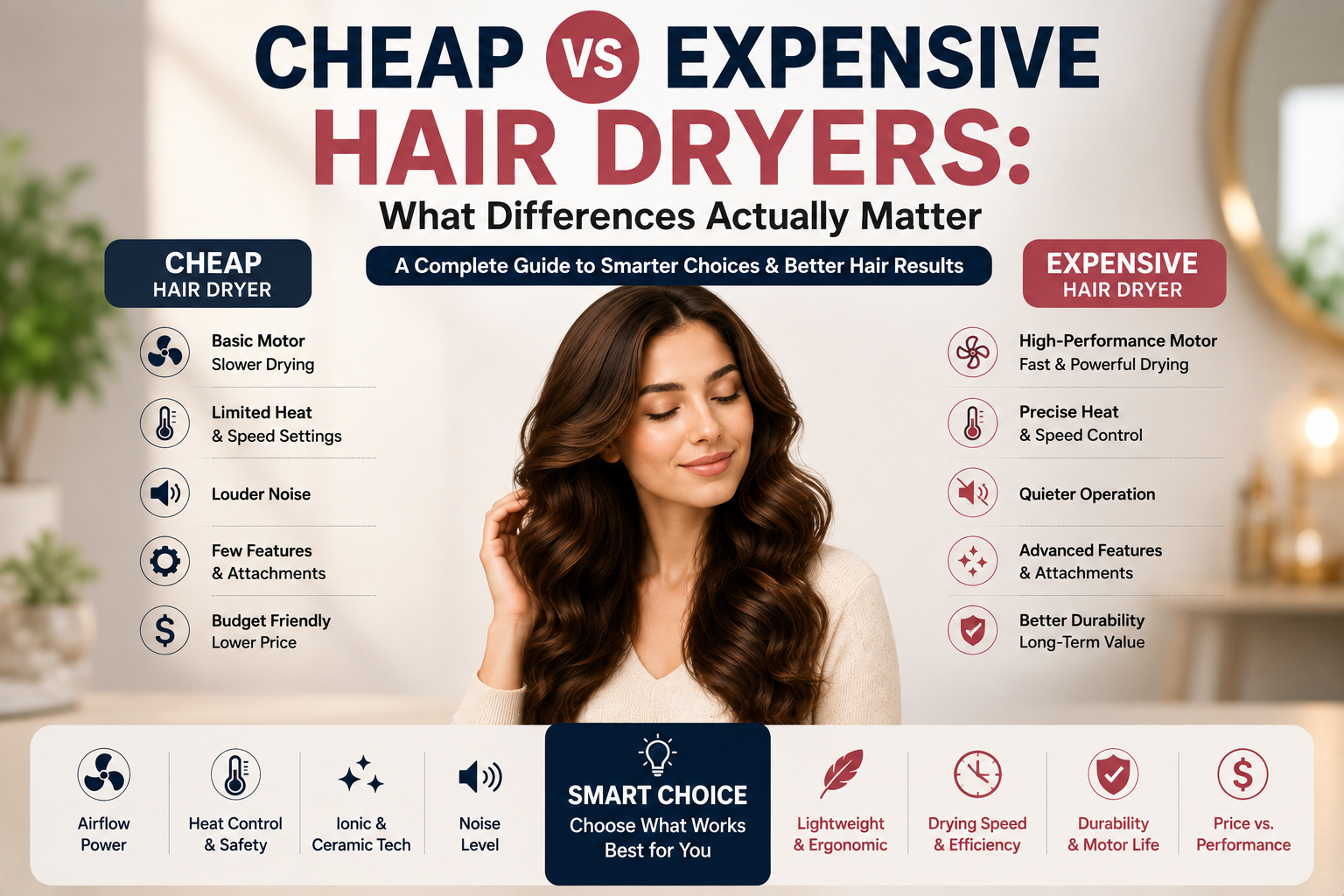
Far-Infrared Hair Dryer vs. Traditional Hair Dryer
| Feature | Far-Infrared Hair Dryer | Traditional Hair Dryer |
|---|---|---|
| Infrared heating | Yes, depending on model | Usually not a primary feature |
| Heat transfer | Infrared + airflow | Primarily heated airflow |
| Drying speed | Depends on airflow and heating design | Depends on motor and heating system |
| Heat control | Depends on model | Depends on model |
| Ionic function | Some models | Some models |
| Hair protection | Depends on temperature and exposure | Depends on temperature and exposure |
| Price | Often higher | Wide price range |
| Best advantage | Controlled heat-focused design | Broad choice and proven simplicity |
The key point is that infrared does not automatically mean better.
A well-designed traditional hair dryer with strong airflow and precise temperature control may outperform a poorly designed infrared model.

Is Far-Infrared Hair Care Worth It?
This is the central question behind Infrared Hair Dryer Benefits: Is Far-Infrared Hair Care Worth It.
The answer depends on your priorities.
Far-Infrared Hair Dryer May Be Worth It If You:
- Dry your hair frequently
- Want controlled heat
- Prefer modern heating technology
- Have concerns about excessive heat exposure
- Want a premium hair-drying experience
- Prefer combining infrared with ionic or ceramic technology
- Value heat distribution and temperature management
For frequent users, investing in a well-designed infrared hair dryer may make sense if the product provides strong airflow, good temperature control, and convenient maintenance.
A Traditional Hair Dryer May Be Better If You:
- Mainly care about drying speed
- Have a limited budget
- Already own a powerful hair dryer
- Do not need infrared technology
- Prefer simple controls
- Rarely use a hair dryer
There is no reason to replace a perfectly functional hair dryer solely because a new model uses infrared technology.
Infrared Hair Dryer Benefits for Different Hair Types
Different hair types have different drying requirements.
Fine Hair
Fine hair can be more sensitive to excessive heat.
A dryer with multiple temperature settings can be useful because users can select a lower temperature instead of relying on maximum heat.
Recommended Approach
Use moderate airflow and lower heat when practical.
Keep the dryer moving rather than concentrating hot air on one section.
Thick Hair
Thick hair generally takes longer to dry.
For this hair type, airflow is extremely important.
Recommended Approach
Look for an infrared hair dryer with strong airflow and good temperature control.
Do not assume that maximum heat is always the fastest solution.
Efficient airflow can significantly affect drying time.
Curly Hair
Curly hair often benefits from controlled airflow.
A diffuser attachment can help distribute airflow more gently.
Recommended Approach
Use a diffuser with moderate airflow and an appropriate temperature.
Avoid aggressively disturbing the curl pattern while drying.
Dry or Damaged Hair
Hair that is already dry or fragile requires particular attention to heat exposure.
An infrared hair dryer may be attractive because of its controlled-heating concept, but the technology does not make excessive heat harmless.
Recommended Approach
Use the lowest practical temperature.
Keep the dryer moving.
Avoid repeatedly drying the same section at very high heat.
How To Use an Infrared Hair Dryer Safely
Even the best infrared hair dryer should be used correctly.
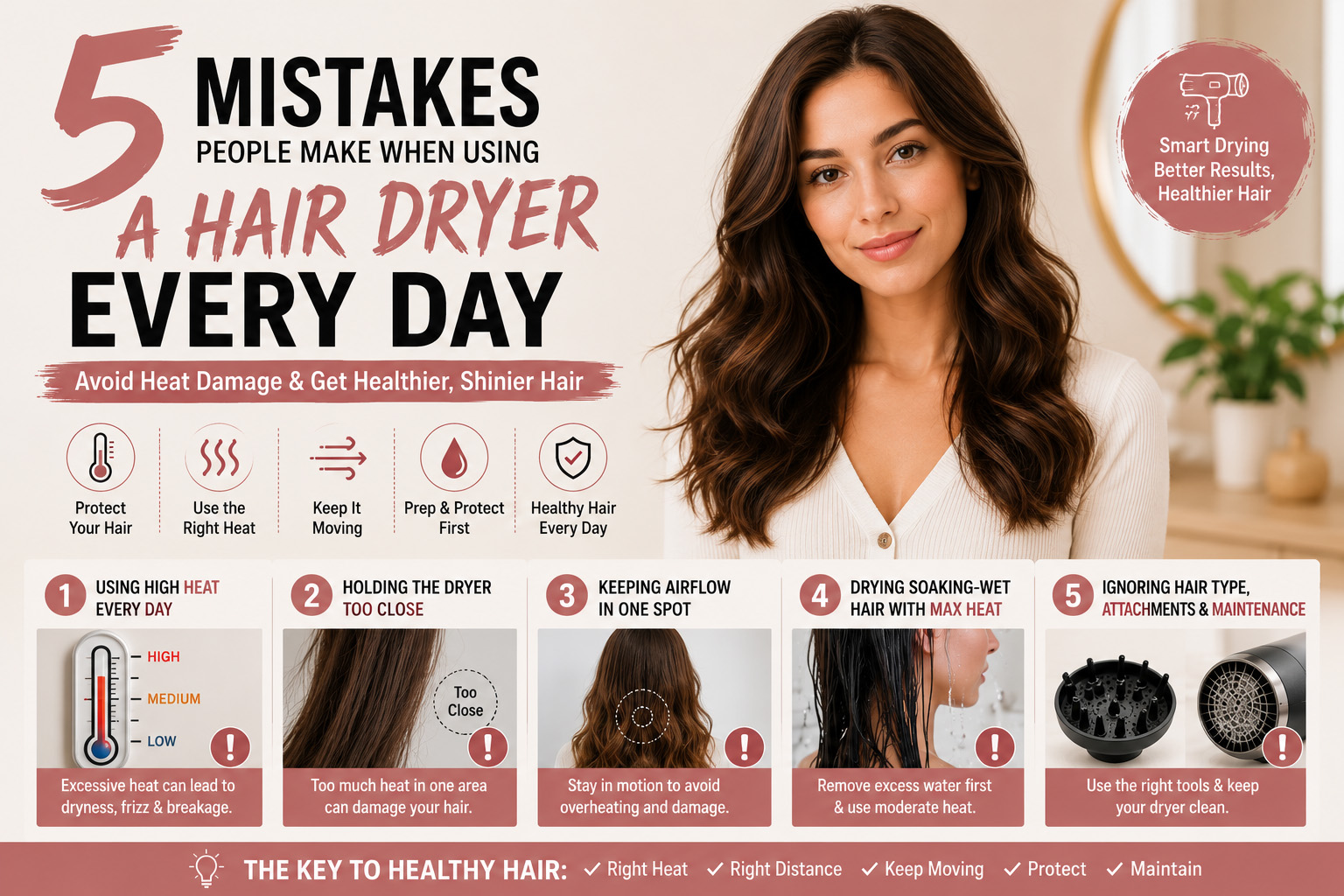
1. Start With Towel-Dried Hair
Do not immediately use maximum heat on dripping-wet hair.
Gently remove excess water with a towel before blow-drying.
Avoid aggressive rubbing because excessive friction can increase tangling and roughness.
2. Select an Appropriate Temperature
Use a lower or medium setting when possible.
Higher heat can reduce drying time, but excessive heat exposure is not desirable.
A Simple Rule
Use the lowest temperature that allows efficient drying.
This principle applies whether you use a traditional, ionic, ceramic, or infrared hair dryer.
3. Keep the Dryer Moving
Avoid holding hot air over one small section for an extended period.
Move the dryer continuously across the hair.
This helps distribute heat over a larger area.
4. Maintain a Reasonable Distance
Do not press the nozzle directly against the hair.
Keeping some distance allows airflow to spread and reduces the chance of concentrated heat exposure.
The exact recommended distance depends on the product and attachment, so follow the manufacturer's instructions.
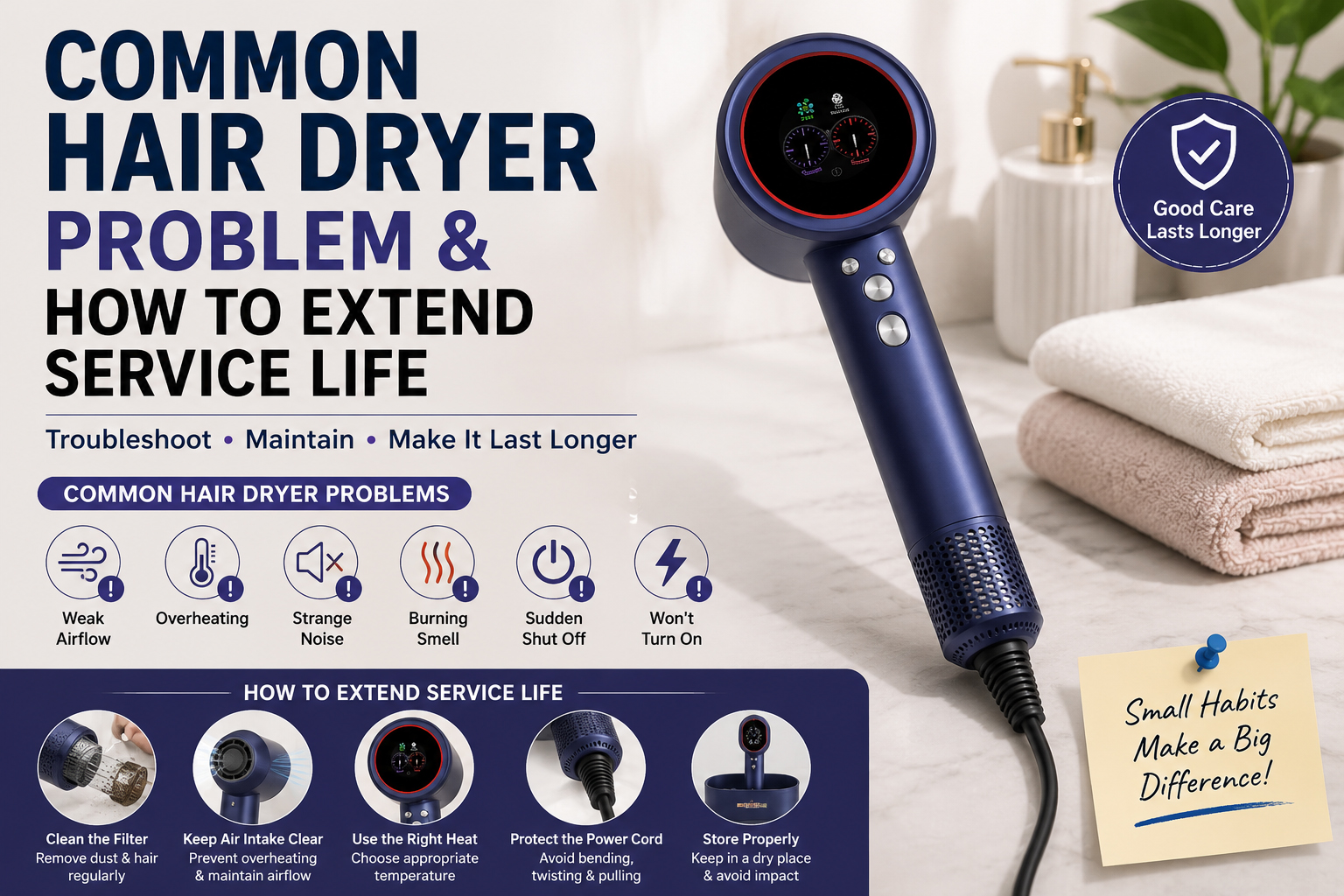
Infrared Hair Dryer Maintenance Tips
Technology alone cannot guarantee long-term performance.
Proper maintenance is still essential.
Clean the Filter Regularly
Dust and hair can accumulate around the air intake.
A dirty filter can restrict airflow and contribute to overheating.
Basic Maintenance Steps
- Turn off the dryer.
- Unplug it.
- Allow it to cool.
- Inspect the filter.
- Remove dust and hair according to the manufacturer's instructions.
- Reinstall the filter correctly.
Do not wash a filter unless the manufacturer specifically states that it is washable.
Keep the Air Intake Clear
Never intentionally block the air intake while using the dryer.
Avoid placing the appliance on soft surfaces that could obstruct ventilation.
Good airflow helps the dryer operate efficiently.
Protect the Power Cord
Avoid tightly wrapping the power cord around the handle.
Do not pull the dryer by the cable.
If the cord becomes damaged, stop using the appliance.
Infrared Hair Dryer Buying Guide
If you decide that Infrared Hair Dryer Benefits: Is Far-Infrared Hair Care Worth It sounds appealing, there are several specifications worth considering.
Look Beyond "Infrared"
Infrared should not be the only buying criterion.
Also consider:
- Airflow strength
- Temperature settings
- Speed settings
- Motor type
- Weight
- Noise level
- Filter accessibility
- Attachments
- Power consumption
- Cord design
- Temperature-control system
Choose Strong Airflow
Strong airflow can be more important than extremely high heat.
A good dryer should remove moisture efficiently rather than depending entirely on high temperatures.
Choose Multiple Heat Settings
Multiple heat settings allow you to adapt the dryer to different hair types.
This is particularly useful if more than one person uses the appliance.
Consider Lightweight Ergonomics
A lightweight infrared hair dryer can be especially convenient for long styling sessions.
Weight distribution matters too.
A well-balanced handle can feel more comfortable than a slightly lighter but poorly balanced design.
Common Misconceptions About Far-Infrared Hair Dryers
Does Infrared Mean Zero Hair Damage?
No.
Infrared technology does not make a hair dryer heat-free.
Excessive temperature and prolonged exposure can still affect hair.
Does Far-Infrared Automatically Dry Hair From the Inside Out?
This is an oversimplification.
Infrared radiation interacts with materials through thermal energy transfer, but the actual drying process involves heat transfer, airflow, evaporation, hair structure, moisture content, and exposure time.
Therefore, claims that every far-infrared dryer literally dries hair "from the inside out" should be treated cautiously.
Is an Infrared Hair Dryer Always Faster?
No.
Drying speed depends on the complete system.
A high-performance conventional dryer with strong airflow can be faster than a lower-powered infrared model.
Is More Heat Better?
Definitely not.
More heat can reduce drying time in some situations, but excessive heat can increase thermal stress on hair.
Efficient airflow and appropriate temperature are usually more important than simply increasing heat.
FAQ
What are the main infrared hair dryer benefits?
Potential benefits include more controlled heat transfer, potentially more even heating, and efficient drying when infrared heating is combined with effective airflow and temperature control.
However, actual performance varies between models.
Is far-infrared hair care worth it?
For users who frequently dry their hair and value controlled heat, modern heating technology, and premium features, a far-infrared hair dryer may be worth considering.
For occasional users, a good conventional hair dryer may provide excellent value.
Is an infrared hair dryer better for damaged hair?
Not automatically.
A controlled-temperature infrared dryer may be useful for people who want to minimize unnecessary heat exposure, but proper temperature, distance, movement, and drying time remain more important than the infrared label itself.
Does an infrared hair dryer reduce frizz?
Infrared technology itself should not be considered a guaranteed anti-frizz solution.
Frizz can be influenced by hair condition, humidity, friction, drying technique, airflow, and ionic technology.
If reducing static and frizz is your primary goal, consider whether the dryer also includes an ionic function.
Is far-infrared hair care safe?
Infrared hair dryers are designed for hair drying, but they still produce heat.
Follow the manufacturer's operating instructions and avoid prolonged exposure to excessive temperatures.
Can I use an infrared hair dryer every day?
Yes, if the product is designed for regular use and used according to its instructions.
Daily users should pay particular attention to temperature, airflow, filter cleanliness, and drying time.
Is infrared better than ionic technology?
They serve different purposes.
Infrared technology relates primarily to heat transfer, while ionic technology is generally associated with reducing static and improving the appearance of frizz.
Some hair dryers combine both technologies.
What should I look for in the best far-infrared hair dryer?
Look beyond infrared technology.
Consider strong airflow, adjustable temperature, reliable temperature control, manageable weight, accessible filter maintenance, ergonomic design, and suitable attachments.
Final Verdict: Infrared Hair Dryer Benefits: Is Far-Infrared Hair Care Worth It?
The answer is potentially yes, but infrared should not be viewed as a magic hair-care technology.
A well-designed far-infrared hair dryer may offer advantages in heat distribution and controlled drying, particularly when infrared heating is combined with strong airflow and temperature management.
However, the most important factors for healthy hair drying remain relatively simple:
- Use an appropriate temperature.
- Avoid excessive heat exposure.
- Keep the dryer moving.
- Maintain a reasonable distance.
- Use adequate airflow.
- Keep the filter clean.
- Choose the correct attachment.
- Avoid repeatedly drying the same section at high heat.
For people who frequently use a hair dryer and want a more advanced heating system, far-infrared hair care can be a worthwhile feature.
For occasional users, a reliable conventional hair dryer with good airflow and temperature control may be enough.
Ultimately, the best infrared hair dryer is not necessarily the one with the most impressive technology claims. It is the one that combines efficient airflow, controlled heat, ergonomic design, reliable construction, and appropriate hair-care performance.

📬 Contact Information
Contact Person: Jenny
Tel / WhatsApp / WeChat: +86 137 1719 2238
Address: No. 12, Donghuan 2nd Road, Huangjiang Town, Dongguan, Guangdong, China
For partnership inquiries, distribution, private label OEM, or large-scale projects, please reach out directly.
Welcome to Hongya!
17+ years OEM/ODMproduction experience.
Main products include: HairDryers, Hot Air Brush, HairStraighteners, Hair Curlers,Hair Straightener Brushes,etc.
20+R&D staff
280+ employees.
15000+ ㎡ factories.
100,000+ PCS MonthlyProduction.
Currently developing200+ products.
Patents/Certifications support Online Query.

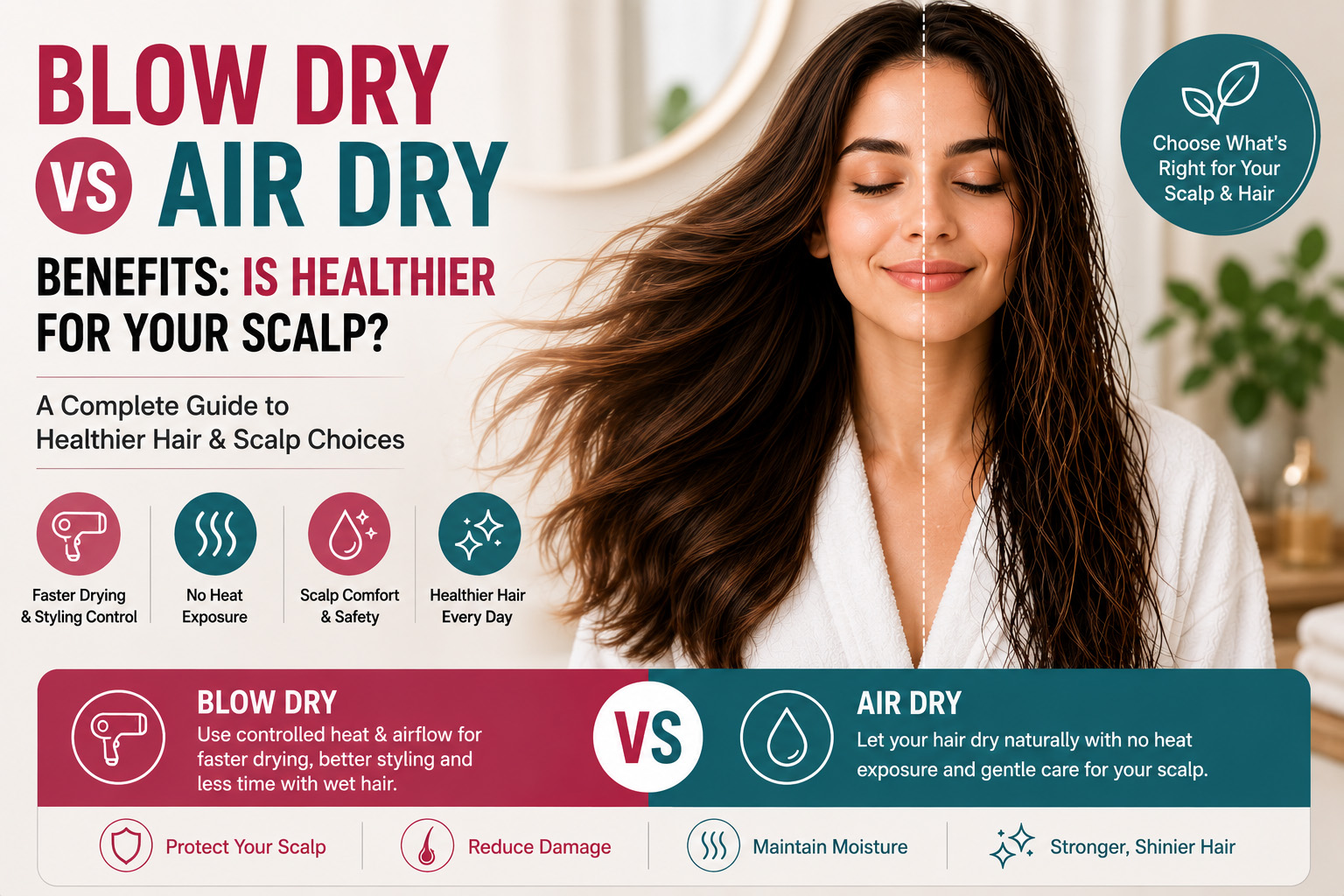
Blow Dry Vs Air Dryer Benefits:Is Healthier For Your Scalp?
Common Hair Dryer Problem & How To Extend Service Life
Related Article